Match the dog to the household you actually run on a Tuesday at 6 p.m., not the one you describe on a Saturday hike. Three things get compared, in this order: the ages of the children living in the house right now, the dog's arousal level around noise and grabbing hands, and the exercise window the family genuinely has on its worst day. Breed reputation belongs at the end, as a tiebreaker. Put it first and you end up with a dog that was perfect on paper and wrong in the kitchen.
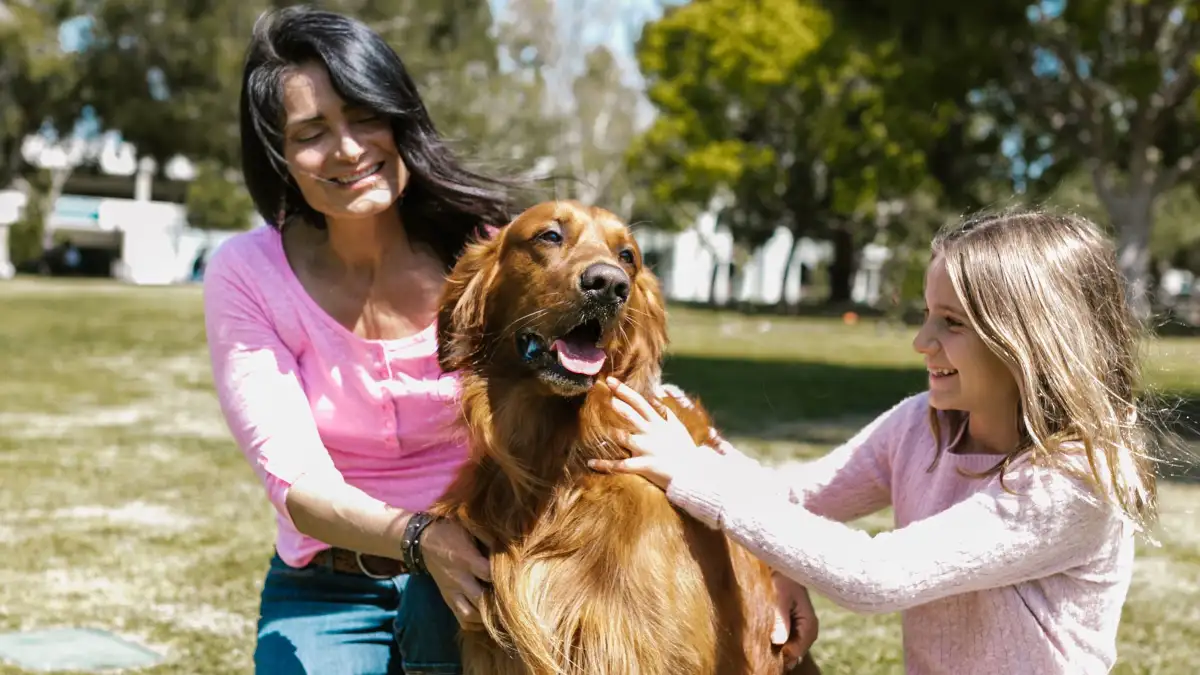
I'm at my counter at 6:20 on a Tuesday. Pasta water is rolling hard enough to fog the window over the sink. The dishwasher is open because someone needed one clean cup. The four-year-old is doing laps around the island in socks, and the seven-year-old is erasing homework with more force than the paper can take. Nobody is being loud on purpose. This is just the noise floor of an ordinary evening.
The dog is either under the table or it isn't.
If it is under the table, and the pot lid clatters, and the dog's head comes up, looks at me, and goes back down, that's the dog. If it stands up and stays standing, drifts toward the kid on lap four, paces the edge of the room where the floor changes, that is also information, and in my experience it outweighs every temperament blurb I have ever read. Ninety seconds of a bad Tuesday beats a page of breed notes.
The worst hour tells the truth, not the average week
Everyone evaluates a household in its best hour. Saturday morning, everybody rested, coffee made, someone says the word walk and the day opens up. Any dog looks manageable in that hour.
So I started paying attention to the opposite end. The hardest 45 minutes of a weekday — the one where dinner is late, one kid is melting down over nothing, someone is running behind, and the phone rings. My rule of thumb after a few years of this: whatever dog lives here has to be able to be in that room without adding to it.
That is a lower bar than it sounds, and a much more honest one. The dog doesn't have to love that hour. It has to not escalate during it. There's a real difference between a dog that lies down and sighs at the noise, and a dog that starts pacing, whining, or working the counters while the room is already at capacity. Only one of those dogs makes the evening easier.
Which hour is yours?
It's rarely the same for two families. In my house it was the stretch between six and seven. For a friend on a shift schedule it was the school rush, same idea, different clock. Name your hour out loud. Then measure everything below against it.
Arousal and energy are two different numbers
This is the part that gets flattened the most, so I'll slow down.
Energy is how much movement and work a dog needs across a week. Arousal is how fast the dog spikes and how fast it comes back down. They're related, but they are not the same number, and for a family with young children the second one matters far more than the first.
A dog can be genuinely low-energy — sleeps most of the day, content on two short walks — and still spike hard the second a child shrieks near its head. A dog can be high-energy and very even: goes up when you pick up the leash, comes back down on the couch ten minutes after. If I'm choosing for a house with a toddler in it, I want the second dog every time, because I can schedule around energy and I can't schedule around a nervous system.
What I actually watch for is two things: the trigger threshold, and the recovery time.
Threshold is what it takes to get the dog up. A doorbell, a dropped pan, a kid running past at arm's length.
Recovery is what happens after it's up. Seconds, minutes, or never. Some dogs are still circling twenty minutes later, and that dog will be circling while you're trying to get a four-year-old into pajamas.
In a meeting room, I ask whether I can do something ordinary and startling. Drop a set of keys on the floor. Have someone walk past the doorway at a normal pace. What I'm watching is not the jump. It's the ten seconds after the jump.
Children's ages, one stage at a time
The age of your kids is the first filter, and the gap between a three-year-old and a six-year-old is bigger than most people expect. I've watched a house change its whole relationship with a dog in eighteen months without the dog changing at all.
Under five
A child this age can't read a dog and can't reliably be taught to. They lean, they hug, they take things out of a bowl, they fall over. What you need here is low arousal and high tolerance — a dog that absorbs a surprise without much happening underneath. Sturdy enough that a body bump doesn't hurt it, steady enough that a shriek doesn't set it off. If a meeting room has that dog and a child in it at the same time, I want to watch the dog, not the child.
Six to nine
Now the kid can hold a leash on a quiet sidewalk and follow a simple instruction. This is where the dog's pulling strength starts to matter more than its friendliness. A friendly, strong dog that lunges once at a squirrel can take a second-grader off their feet. A calmer, lower-drive dog lets the kid actually be part of the walk instead of a passenger on the end of a rope.
Ten and up
This is the age where a higher-drive dog becomes realistic, because you've just added a second handler to the house. A ten-year-old can run ten minutes of trick work, hide a few pieces of kibble around a room, hold a long line while the dog sniffs. That's real work for the dog, and it's genuinely useful.
Teenagers
Teenagers are the most capable and the least dependable people in the house. They can absolutely handle a demanding dog on the days they show up. Do not build the dog's exercise plan on a teenager's schedule unless that teenager has already given you a year of showing up. Build it on the adult who is home sick and still has to walk the dog.
The working-dog arithmetic
Dogs bred to work all day need work most days. Not a hard concept, but it's the one families skip past, because the math is unpleasant.
Add up the exercise the family can deliver on an ordinary Wednesday, not a good Sunday. If it comes to forty minutes, write down forty minutes. Then ask what that dog does with the remaining hours. Under-exercised dogs don't wait politely. They find their own job, and the job is usually the couch cushions, the recycling, or the shoes by the door.
Weekly total is the honest number, and it has to survive real life: the week someone has the flu, the week of parent-teacher conferences, the week it rains four days straight. If the plan only works in perfect weather, it isn't a plan.
Small is not the same as easy
There's a persistent idea that a small dog is the low-effort choice for a busy family. Sometimes it is. Often it isn't.
Small dogs break more easily. A toddler and a very small dog can genuinely hurt each other, and the injury runs both ways — a child who sits on a small dog, a small dog that snaps in panic. Some small dogs are also surprisingly reactive: quick to alert, quick to bark, quick to stay up when the house is loud. And plenty of small dogs get walked far less than they should, because their people assume they don't need it. Some of them need it plenty.
Size, coat, and the person who has to handle it
Adult size isn't about preference. It's about capacity, and it comes down to three plain questions.
Can the smallest adult in the house hold the leash if the dog pulls? Can the dog be picked up and put in a car if it's hurt and can't walk? And who is doing the coat? Shedding and grooming aren't aesthetic choices — they're recurring tasks measured in minutes per day and appointments per month. A coat that needs regular brushing is an ongoing job, and it lands on whoever in the house is already doing the most.
How I'd run the meeting
Meet the dog more than once, on different days, if the shelter or breeder will allow it. Dogs behave differently on a quiet Tuesday and a busy Saturday, and you're trying to buy information, not a moment.
Ask specific questions, not broad ones. Not: is it good with kids. Ask: what was the last home like, how old were the children, where did the dog sleep, what did the dog do when the house got loud. Ask what time of day was hardest. Ask how it handles being stepped on, or a pan dropped on the floor. People who have lived with a dog know these answers, and the answers are worth more than any generalization.
Watch what the dog does after the exciting part. The greeting is noise. The settle is the signal.
The answer is allowed to be not yet
Here's the tradeoff nobody likes. Sometimes the right match for this year is no dog, and the right match two years from now is a dog you'd never have picked today. Kids' needs move fast. A household with a three-year-old and a household with a six-year-old are practically different households, and a dog that would have been miserable in the first can be perfect in the second.
Mismatched arousal is one of the most common reasons dogs get returned, and a return costs the dog more than it costs the family. Waiting a year is not a failure of commitment. It's the same judgment as everything above, applied honestly.
The test stays the same, though, and it's small. It's a Tuesday, it's 6:20, the pasta water is rolling, and the four-year-old is on lap five. Watch the dog. The dog tells you.