Two weeks is enough time to get a newly adopted dog and your children to calm, supervised coexistence, but only if the first three days involve no direct contact at all. Days one through three: the dog gets a room or a gated zone of its own, and the kids only glimpse it from across the house. Days four through seven: short sessions in the same room, dog on a leash, children sitting down. Days eight through eleven: parallel activity, a child reading on the couch while the dog chews something six feet away. Days twelve through fourteen: the first deliberate greeting, a flat hand offered low, an adult holding the leash, the whole exchange over in fifteen seconds. None of that removes risk. What it does is buy you two weeks of watching the dog instead of guessing about it, and day fourteen is a checkpoint, not a finish line.
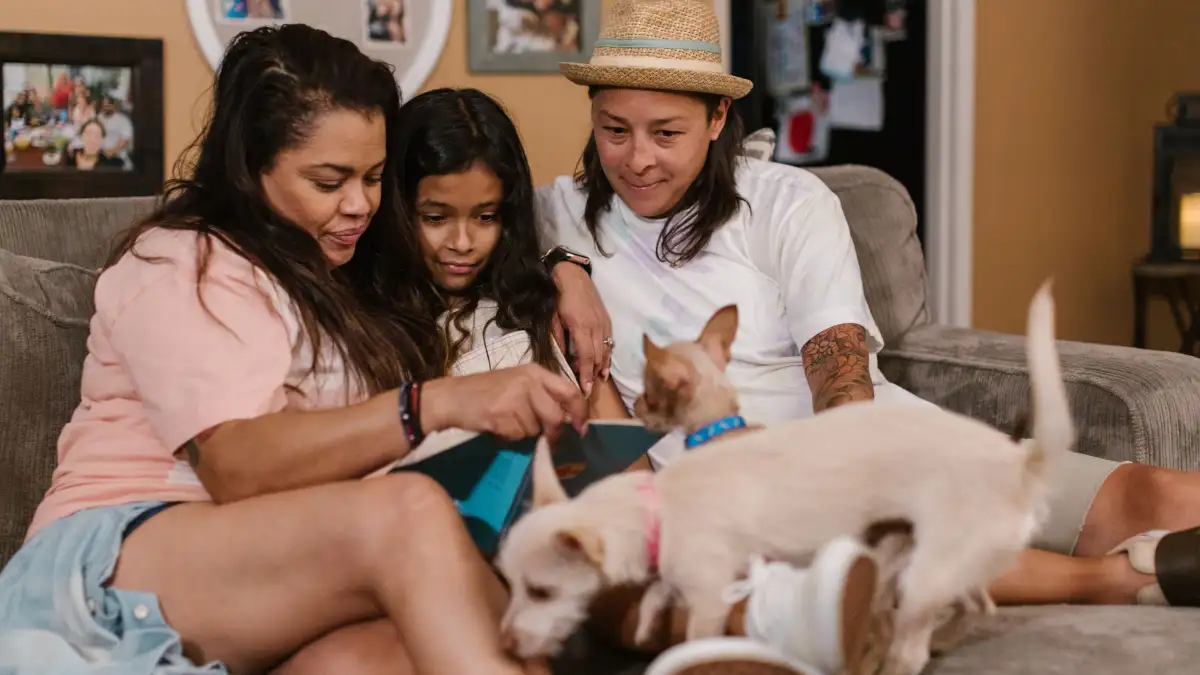
I set the house up before the dog ever walked through the door, because I've learned that decisions made in the first ten minutes of a dog being home are decisions made badly. Here's the layout. A gate at the kitchen doorway. A crate in the corner of the living room where the dog can see us and nobody can reach it without opening something first. A leash on a hook by the door, and a second, lighter one that stays attached to the dog for the first several days, a house line, so that if I ever need the dog to move, I'm guiding a leash instead of chasing a stranger around my own furniture.
That last detail is the one people skip. It's the difference between a household where the dog is loose and everyone is improvising, and a household where the adults always have a hand on the situation.
The setup happens before the dog does
The first afternoon, the kids didn't get to pet the dog. That was the entire plan. My younger one sat on the front step next to me with both hands under her legs while the dog sniffed the sidewalk on a loose leash eight feet away and then turned back toward the car. She was disappointed for about ninety seconds.
A dog coming off a shelter run or out of a transport van is running on stress hormones and has no idea which humans in this house matter yet. A kid running at it with open arms is a lot to ask of an animal on day one. Neutral means the dog has room to leave, the child is seated or standing still, and the whole thing lasts less time than the child wants it to.
Days one through three, the dog lived behind the gate. The kids could look. They could talk in normal voices. They couldn't reach over it, and they couldn't follow the dog into its crate. The crate stays a place nobody bothers the dog, ever, which is worth more to the next two weeks than any amount of early petting.
The kids get one job
I made the kids the vending machine. This is the part I'd tell anyone to steal. Each child got a small jar of treats, and their only job for three days was to walk past the gate, drop one treat into the dog's bed on the far side, and keep walking. No eye contact demanded. No calling the dog over. No waiting to see if the dog liked it.
By day three, the dog was lifting its head when it heard small footsteps in the hall. From a distance, with a barrier between them, the children had become the best thing that happens in that room.
Around day four we started room sessions. Rules for those: dog on the house line, the leash looped around my wrist or pinned under my foot, both kids seated. Couch, floor with backs against the couch, it doesn't matter as long as their bodies are still. Five minutes. Then the kids leave first, not the dog. That order matters more than it sounds like it does. The dog learns that children coming and going is ordinary and that nothing is being asked of it.
Everything is short. That's the rhythm of the whole two weeks. Five minutes, three times a day, beats one forty-minute session where everyone gets bored and somebody gets brave.
By the second week we moved to parallel presence. Same room, no interaction demanded. Kid with a book at one end of the couch, dog with a frozen chew at the other, me in a chair pretending to read. This is the stage people skip because it looks like nothing is happening. Something is happening. The dog is learning that children are background noise rather than events.
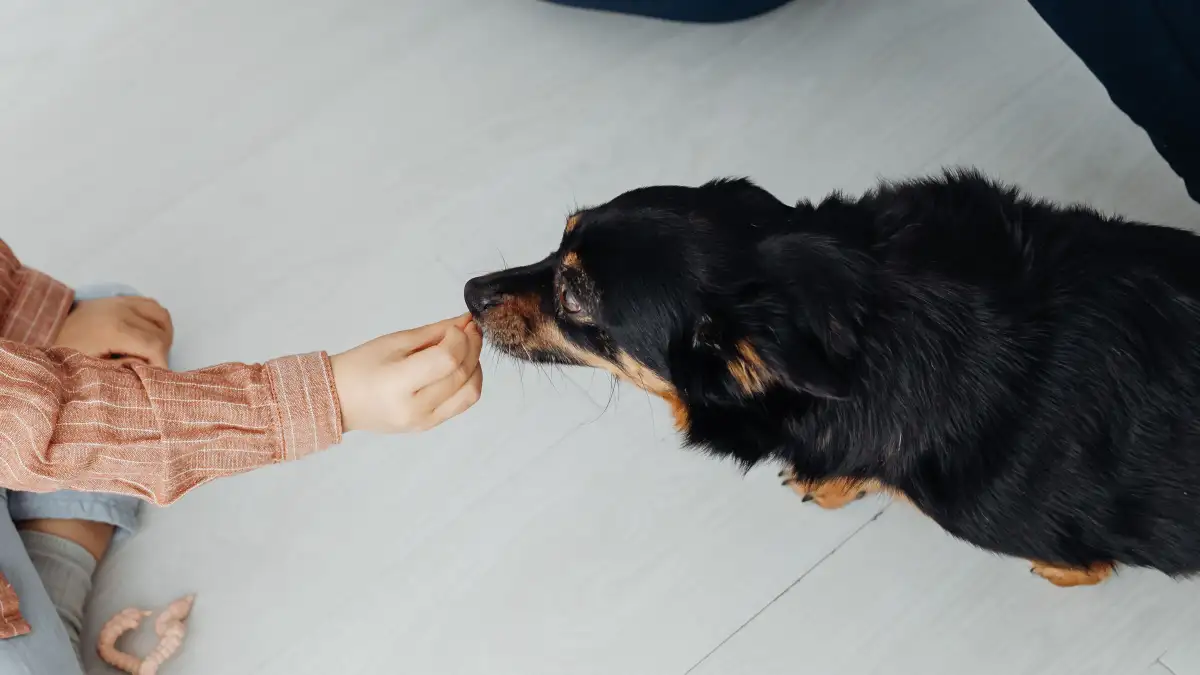
Somewhere around day twelve, if the dog has been loose and easy and the kids have stopped asking every five minutes, you do the first greeting. One child at a time. Dog on leash. Child standing or sitting sideways rather than squared up, hand out flat and low and still, letting the dog come to the hand. If the dog doesn't come, that's a complete answer and the session is over. Fifteen seconds, then the child walks away. The dog gets a reward after the child leaves, not during.
The rules that belong to the children
These are the ones I'd write on an index card and stick to the fridge, because a rule you have to remember is a rule you'll fumble in the middle of a good moment.
No hugging and no kissing. No face-to-face, nose-to-nose anything. A mouth is the closest thing a dog has to a face, and a child's face at that height is the worst possible place to be surprised.
No cornering. Not in the hallway, not between the couch and the wall, not in the crate. A dog with one exit is a dog calculating whether it needs to make an exit.
No taking things. Not the bone, not the toy, not the food bowl, not the thing the dog found under the couch. If the dog has it, an adult handles it.
No lying on the floor with the dog. That's the posture that turns a relaxed dog into a startled one, and it's the one kids default to because it's how they play.
And the rule the adults break: don't let the kids just quickly do anything. Not a quick pet while the dog is eating, not a quick grab for the leash. Quick is exactly the movement that startles.
Reading the dog instead of the calendar
Stress signals are the other half of this, and they're quieter than people expect. Turning the head away. Licking the lips when there's no food around. Yawning in the middle of the afternoon. A body that goes still and stiff instead of soft. The sideways look where you can see the whites of the eyes. A tail that tucks. And growling, which is the dog using its words and is the single most useful thing a dog can do before anything worse happens.
If you see any of it, the interaction is over. Kids leave. Not the dog. Sending the dog away for growling teaches it that the warning doesn't work, and a dog that has learned its warning doesn't work has one fewer option the next time.
Pacing comes from information, not from optimism. Call the rescue or the breeder before the dog comes home and ask one question: has this dog lived with children, and how old were they? A dog that shared a house with a nine-year-old is a different project from a dog with an unknown history. If the answer is that nobody knows, you don't cancel the adoption. You extend the gate days. Two weeks becomes three. The dog has no idea it's on a schedule, so the schedule is yours to move.
Two things I won't pretend away. First, a toddler cannot follow any of these rules, which means with a two-year-old the gate isn't a training tool, it's the whole system, and it stays up for months, not days. Second, some dogs should not live with young children, and that isn't something anyone diagnoses from a blog post. If the dog is stiff every time a child enters the room after two weeks of careful work, or if the growling escalates instead of settling, that's a call to your veterinarian or a behavior professional who can actually see the dog. Getting that help early isn't failure. It's the same instinct that got you this far.
Day fifteen at our house looked like this: dog asleep on the living room floor, kid on the couch under a blanket, gate still latched because I hadn't decided yet, nobody touching anybody. That was the win. Not a hug. A room with two species in it and nobody bracing.