A cleanser formulated for canine ears is the only liquid that belongs inside a dog's ear canal. Human ear drops, rubbing alcohol, hydrogen peroxide, vinegar, plain water on its own, essential oils, tea tree oil, and anything mixed up at home stay outside it — and more than one of those can damage the thin lining that keeps a canal healthy.
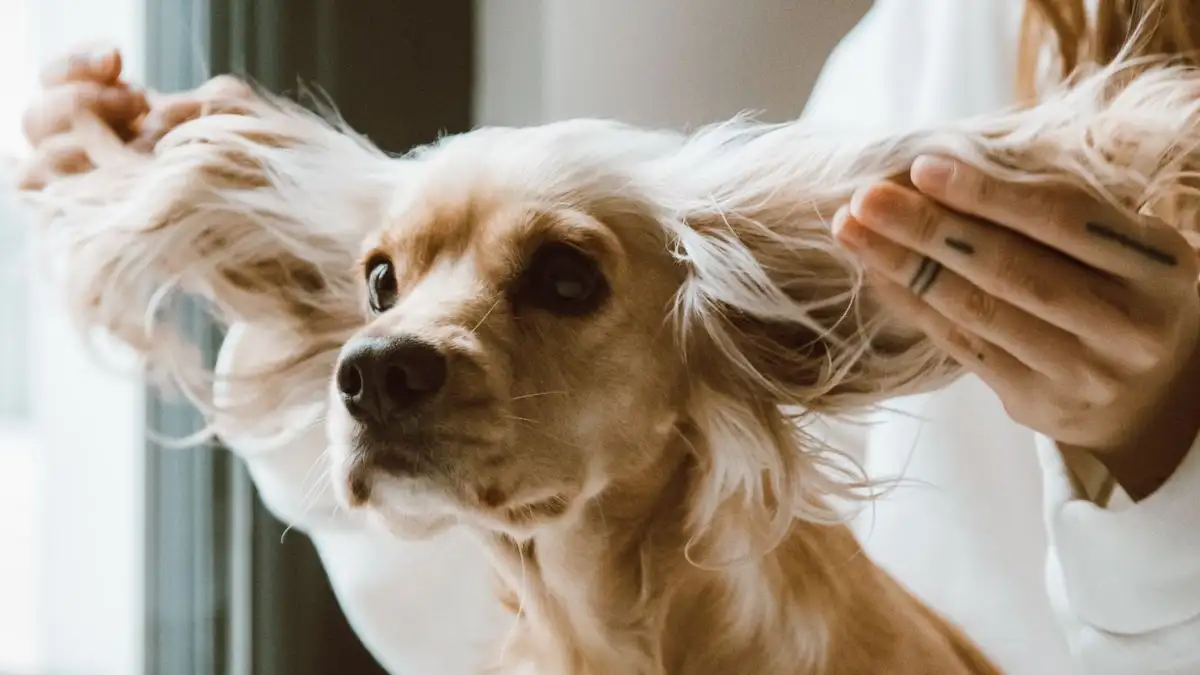
Here's the moment I want you standing in. Sunday evening, bathroom counter, overhead light, a bottle held close enough that I'm squinting at print meant for people with younger eyes. My dog's chin is parked on my forearm because he heard the cabinet open and has decided, against all evidence, that this is about food. The front of the bottle is shouting at me. Gentle. Soothing. A spaniel with clean, happily floppy ears. None of that is information. I turn it over.
Three questions I ask the back of the bottle
I look for the intended-use line first, usually tucked under the directions in type so small it's clearly not what the company wants me to notice.
Who is this made for? If the label says for dogs, or for dogs and cats, it stays in my hand. If it says for human ears, or says nothing about species at all, it goes back on the shelf. A dog's canal sits at a different pH than a person's, and it's shaped differently too — a curve, not a straight shot. A human ear drop was formulated for a human ear. Nobody built it around a dog's wax.
What is it supposed to do to the wax? This is the question most people skip. What's in a dog's ear is cerumen — waxy, tacky, and not something that dissolves in water. A cleanser worth its shelf space is made to break that wax down so it can be lifted out on a cotton ball instead of shoved deeper. If the only claim on the bottle is gentleness, I genuinely don't know what it's doing in there.
What does it leave behind? I want a dry canal when I'm done. Anything that leaves moisture sitting in a warm, dark, closed tube is working against the reason I opened the cabinet.
If I can't answer all three from the label, the bottle goes back and I come at it with a question for the vet instead.
The list of things that never go in
This part I don't hedge on.
- Human ear drops. Wrong pH, wrong formulation, made for the wrong ear. There's a reason they live in my medicine cabinet and not on the shelf with the dog's supplies.
- Rubbing alcohol. It stings on broken skin, and a dog's canal lining is thin. It also strips and dries whatever it touches.
- Hydrogen peroxide. People trust it because it fizzes — the foam looks like proof that something is happening. What it's actually doing is reacting with tissue, and that reaction doesn't know the difference between debris and the lining it's sitting against.
- Vinegar, white or apple cider, diluted or not. This one travels through dog circles as a home standard, and I understand the appeal — it's in the kitchen, it's cheap, it seems mild. It's an acid, and it's going into a canal with its own chemistry.
- Essential oils and tea tree oil. Concentrated, strong, and applied to tissue that absorbs. My rule for anything going near my dog's head is simple: I don't use a liquid he can then lick off his own paw.
- Anything mixed at home. Not because every kitchen idea is poison, but because I have no way to know the concentration I've created, and neither does anyone following the same tip from the same video.
If a veterinarian has specifically directed something for your dog's particular ear, that's a different conversation — that's a clinical decision about your dog, not a general rule you can hand to a stranger online.
And I want to be plain about something else. None of the things on that list are treatments. Neither is a proper cleanser. A cleaner cleans. If there's a smell coming off the ear, if the flap is red or hot, if he yelps when I touch the base of it, if he's shaking his head or holding it tilted, that isn't a cleaning problem. That's a phone call.
Water is not the neutral option
The thing I hear most often is that plain water is the safe fallback — that if you don't have a real cleanser on hand, water is better than nothing.
It isn't. Water doesn't cut through cerumen; it beads on top of waxy debris and rolls past it. Then it stays. A canal that's damp after a bath or a swim is a canal that's about to be uncomfortable, and getting it dry is half the point of cleaning it in the first place.
So if all I have is water, here's what I actually do: wipe the parts I can see — the flap, the visible ridges, the folds around the opening — with a cotton ball or a square of gauze, dry them with a second dry square, and leave the canal alone until I have the right bottle in the house. Doing less in that moment beats doing the wrong thing twice.
What touches the ear, and what doesn't
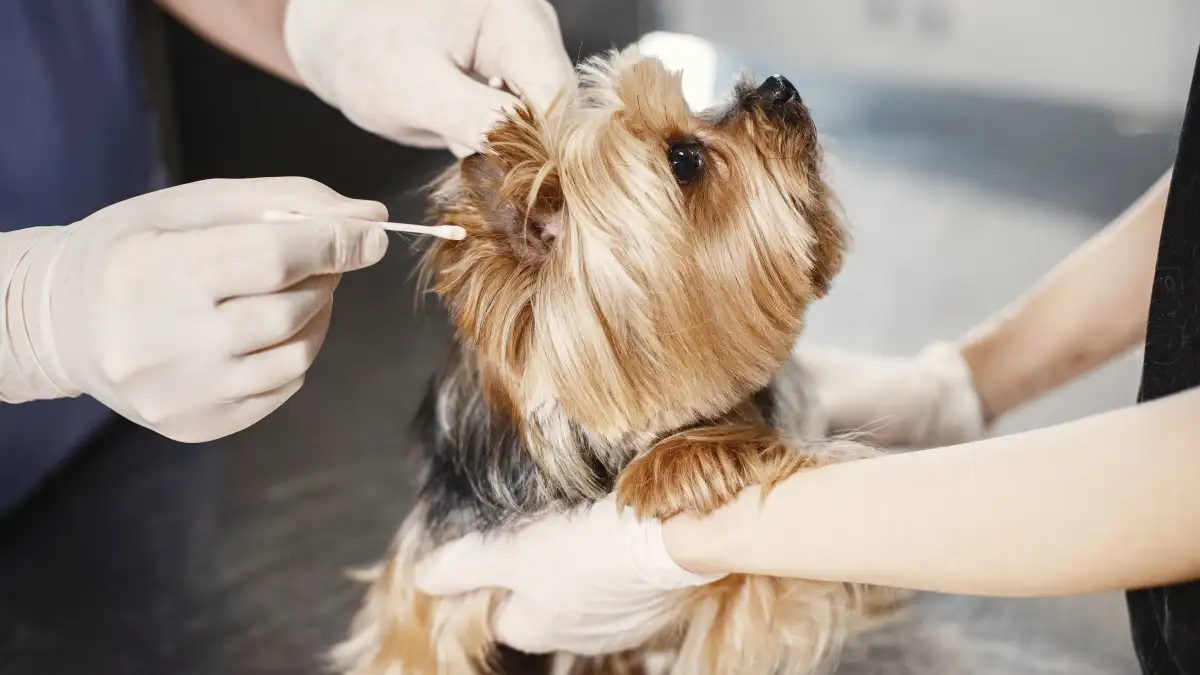
Cotton balls and gauze pads. That's the entire toolkit for the parts you can see.
Cotton swabs go in the trash, at least as far as ears are concerned. I know the urge — you can see a speck of brown right there at the edge, and a swab is the only thing thin enough to reach it. But the canal isn't a straight hallway. It bends, and past that bend you're working blind, pushing exactly the material you're trying to remove toward the eardrum. The visible outer ear is the whole job. Anything deeper than that either comes up on its own after a proper cleanser and a good shake of the head, or it's the vet's business.
I keep a stack of gauze squares in a zip bag on the same shelf as the cleanser — not next to my own toiletries, not next to the dog shampoo. It sounds fussy. It's also the reason I've never once grabbed the wrong bottle at seven in the morning.
The question worth asking the vet
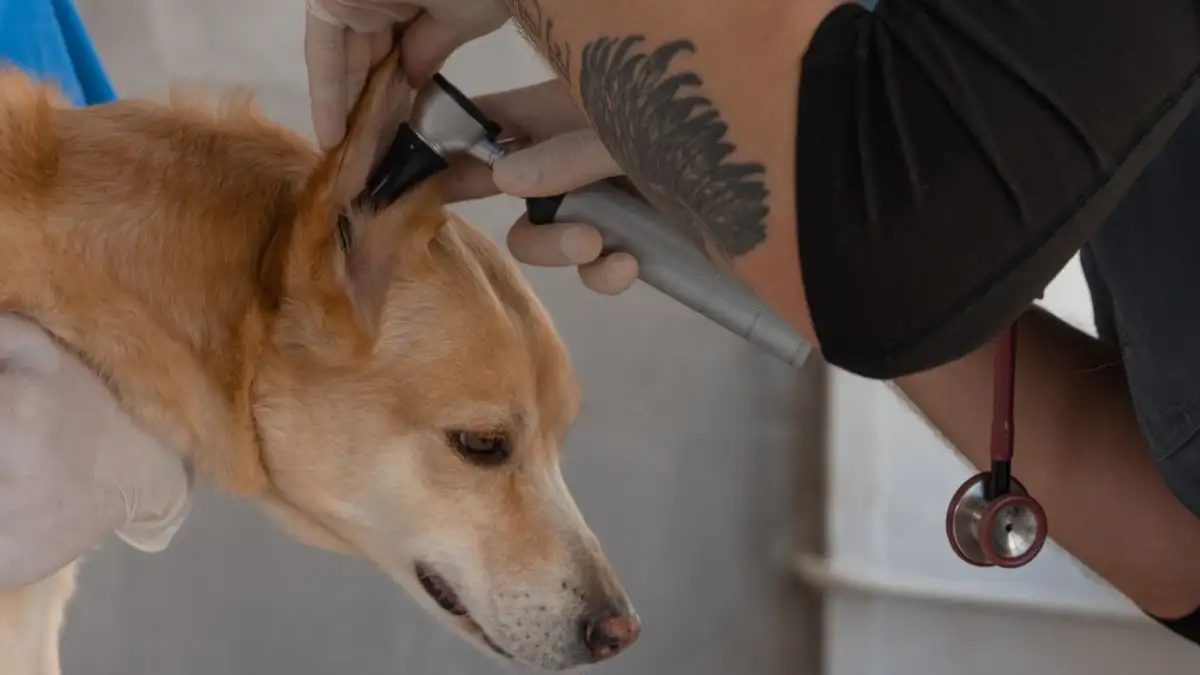
"What should I use on his ears?" is a decent question. The better one is: "Given what you see in there, which type of cleanser fits him?"
Cleansers aren't interchangeable. Some are built to dry a canal out, which is what makes sense for a dog who swims every weekend or who seems to generate wax faster than average. Others are gentler, meant for routine upkeep on a dog whose ears are basically fine. Some carry an ingredient aimed at the conditions a particular dog is prone to. If your dog has allergies, a history of ear trouble, hair growing down inside the canal, or a canal that's unusually narrow, the category matters more than the label on the front.
I ask at the annual exam, when the ears are already being looked at, and I write the answer on the box in marker so future me doesn't have to remember it. That one habit has saved me more guessing than any article, including this one.
The whole filter, short
Made for dogs. Made to break down wax. Leaves the canal dry. Never used as medicine.
If a liquid can't pass those four, it doesn't go in the ear. The ones that fail hardest are usually already sitting in your bathroom.