Clean a senior dog's ears at floor level, on a surface that does not slide, in sessions short enough that the dog never has to hold a position it cannot hold. One ear per sitting is a complete session. The job ends on the dog's signal, not when the cotton ball comes back clean.
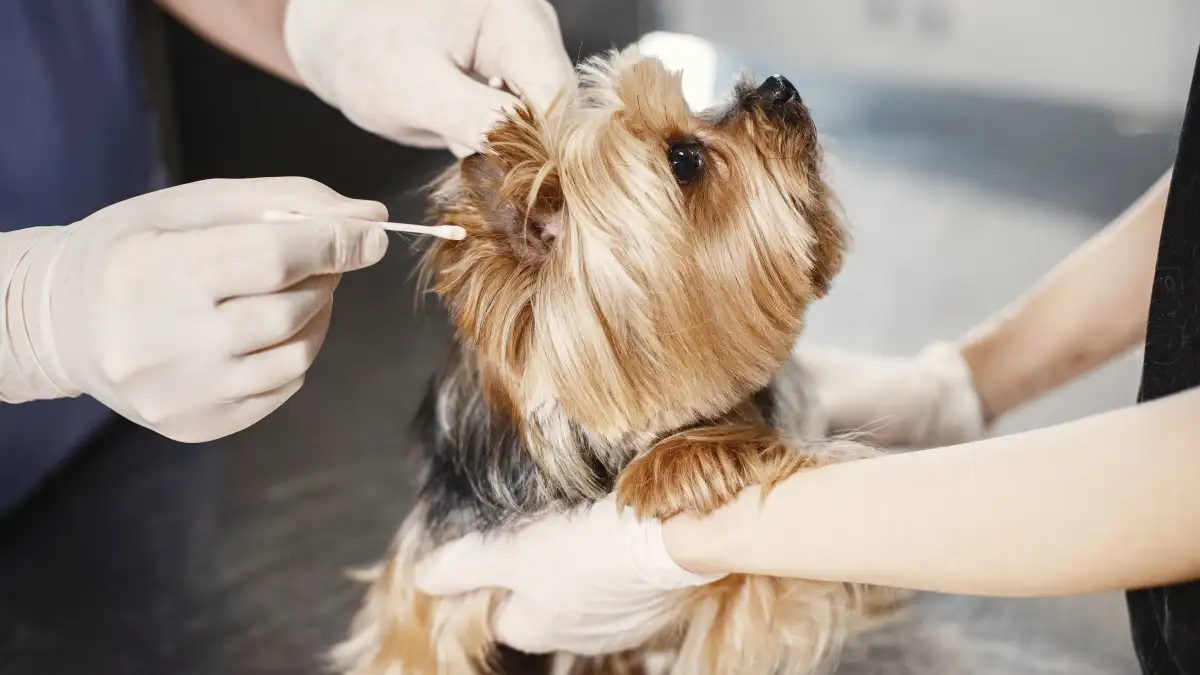
I set everything down before the dog comes into the room. Bottle, cotton balls or soft gauze, a dry towel, three treats cut small, all of it within reach of the mat. The moment I stand up mid-clean to fetch something, the dog reads it as an exit and starts shifting weight, and shifting weight on hard tile is the exact thing I am there to prevent.
Start With the Floor, Not the Ear
The floor is the whole trick, and it took me a while to trust that.
A dog on a table is a dog being held up. For an older dog with hips, elbows, or a spine that has opinions, balancing on three legs while the fourth is being handled is a lot to ask, and it is asking at the worst possible moment. On the floor, four feet stay down. If one foot has to lift, the other three carry a load they have carried for years.
Put the mat down and shove it with your foot. If it slides across the tile, it is the wrong mat. What works is a rubber-backed bath mat, a cheap yoga mat, or a rug with a pad underneath. What does not work is the bare bathroom floor, which is where most people try this, because that is where the sink is. You do not need the sink. You need the bottle, and the bottle can sit on the floor beside you.
Long nails make this worse. A dog whose nails have grown out past the pad cannot get grip on anything, mat or no mat, so if the feet are skating, that is worth knowing before you blame the surface.
Positioning Is Support, Not Restraint
Standing is usually the easiest position for an old dog, and you do not need the head up to clean an ear. The canal drops down from the opening before it turns inward toward the eardrum, so a level head drains and opens just fine. A hand under the chin is bracing. A hand gripping the muzzle is restraint, and restraint makes a dog brace back, which pushes the pressure straight into the joints that already hurt. Bracing gets cooperation. Restraint gets a tug of war, and the dog always wins the tug of war eventually.
If your dog would rather lie down, let them, but understand the geometry. Lying on the side puts one ear against the floor and out of reach. That ear waits for another day. Rolling a stiff dog over to get the second ear is a separate maneuver with its own risks, and it is not worth doing in the same sitting.
If the dog's back legs slide out into a half-sit, do not hoist them back up by the hips. End the session and let the dog get up on their own schedule.
Cues for a Dog Who Can't Hear You Anymore
Hearing loss sneaks up. For a long time you think the dog is ignoring you, and then you realize they never heard you.
So approach from the front, inside their field of view, every time. Never walk up behind a sleeping old dog and touch their head. A dog who does not hear you coming startles hard, and a startled dog on a slick floor is a fall waiting to happen. I tap the floor a few feet away where they can see my hand, or I just hold a hand up at chest height and wait to be seen. It costs four seconds.
The signal for ears should be a shape, not a word. A word means nothing to a dog who cannot hear it. I show the bottle. I sit on the floor first, where they can see me at their level, and let them see the bottle in my hand before I touch anything. That sequence being predictable matters more than being fast. A dog who knows what is coming next holds still longer than a dog who is being surprised in slow motion.
Warm the solution. Cold liquid in an ear is startling in a way that has nothing to do with pain. I stand the bottle in a bowl of warm water for a few minutes and test a drop on the inside of my wrist.
Short Sessions, and What Short Actually Means
Ten to fifteen seconds of actual work in the canal is a session. Not a minute. Not "until it looks clean."
The rule I use is that the session ends before the dog wants it to end. I would rather leave a little wax in there than spend the next three days rebuilding trust with a dog who remembers that the last time went on too long. Wax that stays behind is not a crisis. It comes up again next week, and the week after.
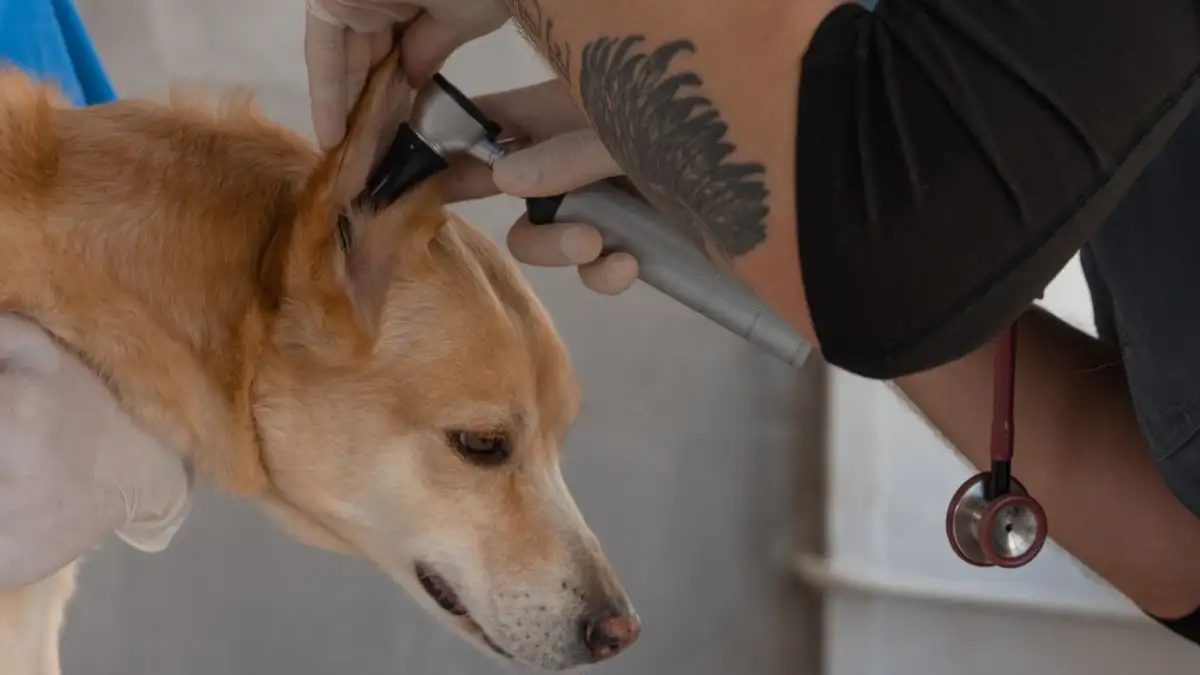
You are cleaning what you can see: the folds of the ear flap, and the first part of the canal below the opening. The rest turns a corner toward the eardrum and belongs to a veterinarian with an otoscope. Do not push anything down the canal to reach it. Nothing in a dog's ear canal needs to be packed or pressed into place.
If the bottle in your cabinet is something a person would use on a cut, it is not for an ear canal. Use what your veterinarian has already approved for your dog, and if you do not have that, ask before you start.
The Signals That End It
A yelp. A pull away. A head shake that will not stop. A front paw lifting and not going back down. A back leg sliding out. A sudden sit. Any one of those ends the session. Not pauses it, not "let me try once more from a different angle." Ends it.
A yelp or a loss of balance during ear cleaning is a call to the veterinarian, not a puzzle to solve at home. Something changed, and you are not the one who can see what it is.
Same goes for anything that looks different from last time. More wax than usual, or a canal that feels dry when it used to feel waxy. Redness, a smell, discharge, a head tilt that wasn't there before, scratching at one ear more than the other. Old dogs often do produce more wax, and old ear canals do tend to run drier, so both can be normal. The word that matters is change. Change gets a veterinarian's eyes on it, not a home remedy and not a different cleaning technique.
The Small Things That Change Everything
Timing. Not right after a walk, when the dog is still wired. Not first thing in the morning, when the joints have not loosened up. Mid-afternoon, after the dog has moved around the house a while, is when I have the least resistance and the calmest body to work with.
Temperature. Old dogs run cold. A cold bathroom floor is a bad place to ask for stillness, so I shut the door and let the room warm up, or I do this in whatever room the dog already chooses to nap in.
Light. I want to see into the ear, which means a lamp pulled close or a small flashlight, not the dim overhead light at nine at night.
And after: a treat, a hand flat on the shoulder for a few seconds, then let the dog walk away on their own. Not a party, not a fuss. Just a clean ending, so the next session starts from the same place this one did.