Most ear cleaning fails for a structural reason, not a technique reason: a dog's ear canal drops straight down from the ear opening and then turns sharply inward toward the eardrum, so anything pushed past that turn carries wax deeper instead of lifting it out. Routine cleaning belongs on the outer ear only, the visible folds and the first short stretch of canal. An ear that smells, hurts, leaks discharge, or leaves the dog tilting its head is a veterinary exam, not a longer cleaning session.
I keep coming back to a Saturday morning in my bathroom, my dog sitting on the tile with her head leaned against my knee, the overhead light doing what overhead lights do. Cotton ball in one hand. A bottle of ear cleanser in the other, the kind sold for dogs and not for people. Nothing about the moment felt like a mistake.
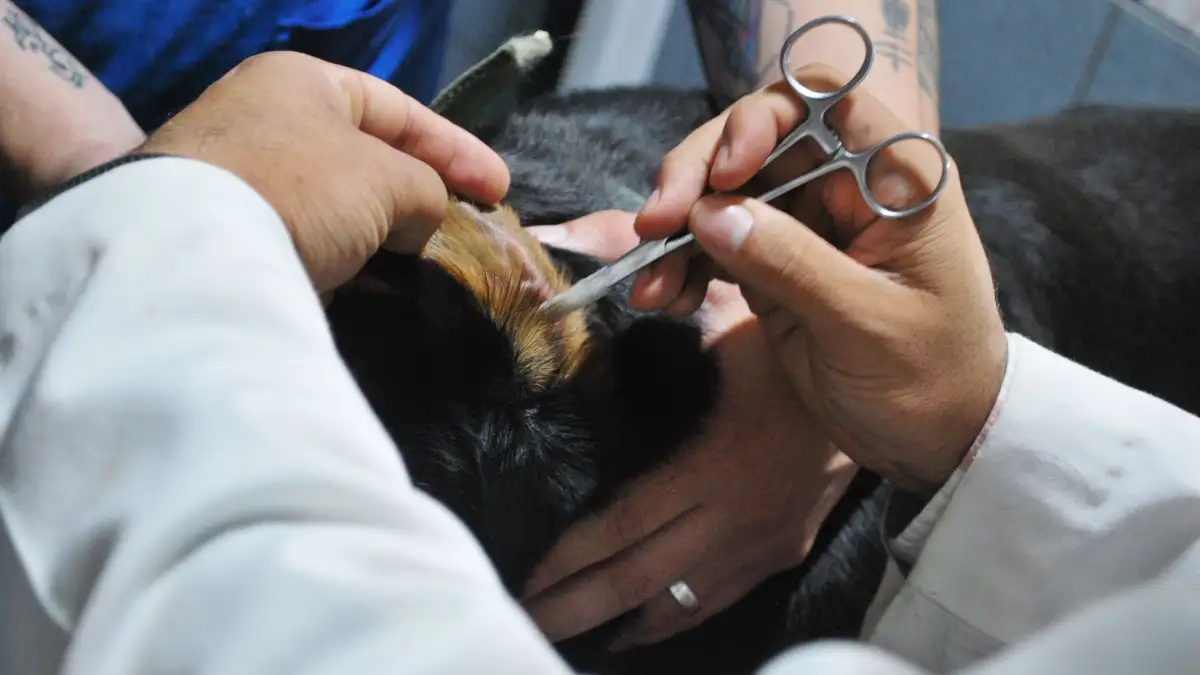
Here is what was actually there when I folded the ear flap back. A pale pink ridge. A little dark wax at the edge of the opening, the color of coffee grounds, sitting right where a wipe could reach it. And past that, maybe half an inch in, the canal disappeared into shadow. You can see the wax. You cannot see where the wax is going.
That shadow is the bend. The canal runs down, then turns sideways toward the skull, and the eardrum sits at the far end of that turn where nothing on a cotton swab reaches it safely. Everyone who has ever cleaned a dog's ear has stood in that exact spot, seen that shadow, and felt the same pull: go get something thinner.
The shape you are working with
Don't. That pull is the trap, and the trap is made of plumbing. Wax in a dog's ear lines the walls. It does not sit in the middle of the tube like a clog you can hook out. Push a swab down to the bend and you press the lining against itself, packing the wax into the curve instead of removing it. Then you do it again next week. And again the week after. Each time, a little more of what was loose becomes a plug.
By the time most owners notice the ear is worse, more smell, more scratching, more head shaking, the wax is no longer at the opening. It is sitting against a membrane far thinner and far less forgiving than the wax around it.
I know this because I did it. Not once. Long enough that I had built a whole routine around the wrong end of the ear.
Thirty seconds before you touch anything
Now I run the same check every time, and it takes about half a minute.
Look. Pale pink is what you want, with maybe a little wax at the opening. How much wax is normal varies enormously from dog to dog. Some ears stay almost clean for years. Others produce visible brown wax every few weeks. What you are looking for is change. Brown, black, yellow, or green discharge is a stop. So are redness, swelling, or crusting along the edge of the flap.
Smell. A dog's ear smells like a dog. That is the baseline. What should stop you is a yeasty, sweet, sour, or outright foul smell, because that is not dirt. That is a population change inside the canal, and no amount of wiping fixes it.
Press. This one matters and most owners skip it. Rub gently at the base of the ear, right below the opening where the canal meets the head. A comfortable dog leans into it. If your dog pulls back, yelps, or swings its head around, that is your answer, and the answer is not clean it more. Pain in an ear means stop and call the vet. Same with a head tilt, circling, or any wobble in balance. Those point at structures well past anything you can see.
When cleaning is even the right answer
Here is the part that surprised me most. Most healthy ears do not need routine cleaning at all. They maintain themselves. If your dog's ears are pale, dry, and unremarkable, the correct number of cleanings per month is usually zero, and the correct amount of interference is the same.
Outer-ear cleaning makes sense for a narrower group. Dogs who lay down visible wax quickly. Dogs who swim or get bathed often. Dogs whose ear shape holds moisture, whether that is a heavy flop of a flap or a canal narrowed by anatomy or old scarring. If your vet has told you your dog is one of those, that is your answer, and how often is a question for them rather than for a general guide. I wipe my own dog's outer ear when I can see wax at the opening, maybe once a month in winter and more often in summer when she is in the water every weekend. That is her. It is not a schedule.
Wiping more often than a dog needs does not make the ear cleaner. It abrades the skin lining the canal, strips the thin layer of wax that is doing its job, and leaves the ear red and itchy in a way that looks exactly like the problem you were trying to prevent. Two weeks of daily wiping can create the redness you were worried about in the first place.
Doing the wipe
Cotton ball or a square of gauze. Cleanser made for dogs, the ordinary kind, not medicated, and not anything from your own medicine cabinet. Household liquids that people reach for are not made for a dog's ear, and some of them damage tissue inside a canal you cannot inspect.
Dampen the ball, do not soak it. Wrap it around your fingertip and wipe the inside of the flap, then the pocket where the flap meets the head, then the short visible stretch of canal. One pass, fresh ball, repeat until the ball comes away mostly clean. That is the whole procedure.
What you never do: pour cleanser straight into the canal, and never insert anything. No swabs. No rolled tissue. No fingertip past the opening. If you cannot see it, you cannot clean it, and you should not try.
Drying is the step everyone skips. After a swim or a bath, take a dry cotton ball or a soft cloth and blot the outer ear and the folds. Water that stays sitting behind the bend is exactly the environment yeast and bacteria are waiting for. Some dogs who seem to get ear trouble every August are simply dogs who are in the lake every August.
One more thing that comes up. Some groomers pluck hair from the ear canal, and some owners are told to. That is not routine care. Plucking irritates the skin lining the canal, and irritated skin is more hospitable to the things you are trying to avoid. If it comes up, that is a conversation for your vet, not a standing appointment.
Signs that end the session
Odor. Discharge. Redness or swelling. Pain when the ear is touched. Head tilt. Balance problems. Constant scratching at one ear. Any one of those and the ear has stopped being a cleaning problem. Put the cleanser down. Do not try a drop of anything. Make the appointment. What is happening behind the bend is not something you can see, reach, or fix, and the tools for it are prescription.
Holding still without a wrestling match
If your dog squirms the second your hand comes near the ear, holding it still makes the next attempt worse, and the one after that worse again. Go smaller instead. Touch the flap, give a treat, let go. Thirty seconds, three times a day, for a week. Then lift the flap and look, treat, let go. Build up to a single wipe. Treat everything.
If your dog still will not let you lift the flap after a couple of weeks of that, that is information. Either it needs more time, or the ear hurts. A dog who was fine with ear handling last month and is not fine now is worth a phone call.
I can wipe my dog's outer ear, dry it after a swim, and watch it. That is the entire job. I cannot see around the bend, and neither can you, which is why the most useful skill here is not technique at all. It is knowing where the wiping stops and the phone comes out.