Chewing bones and dental chews do not clean a dog's gumline, and the gumline is where the problems that cost teeth and money actually begin. A chew works the flat tops and outer sides of whichever teeth the dog chooses to grind on, then slides past the shallow groove where the tooth meets the gum — the one place a soft-bristled brush is built to reach. Plaque starts to harden within 24 to 48 hours, so brushing close to daily is what keeps it from getting a foothold. For a dog that has never had anything in its mouth but food and chews, the way in is not a harder chew or a longer session. It starts with dog-safe toothpaste on a fingertip and ends, four or five weeks later, with a brush tracing the gumline of the upper back teeth.
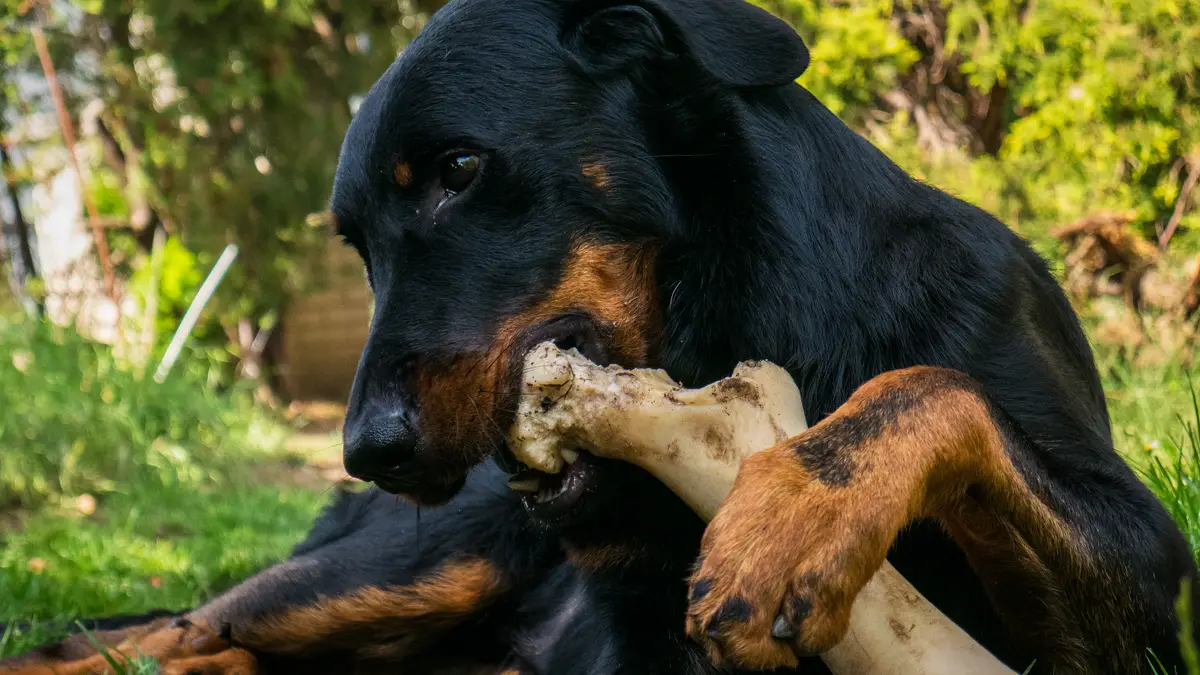
I spent two years feeling quietly pleased with myself about the chew I handed over every evening. My dog took it seriously: head tilted, one hind leg braced, fifteen minutes of grinding. It looked like dental work. Then a vet lifted her upper lip with a thumb, angled the light, and let me look at the one place I had never looked — the line where the tooth disappears into the gum. Red and puffy all along the margin. The crowns were fine, mostly. I had been staring at the white part the whole time.
That was the day I stopped thinking of a chew as a toothbrush and started thinking of it as something my dog enjoys that happens to rub against some teeth.
What a chew physically touches
Watch a dog work a chew instead of reading the label. The jaw moves in short, heavy strokes with a little sideways slide. Contact lands where the chew meets a cusp — usually a couple of lower premolars and that big shearing tooth in the upper jaw. It's a lot of force concentrated on a small area, and nearly all of it stays above the gum margin.
Now picture where trouble starts. The groove between the tooth and the gum is only a millimeter or three deep in a healthy mouth. That sounds like nothing. It is also where plaque bacteria settle first, because it's warm, it's wet, it's sheltered from the tongue, and nothing a dog can put in its mouth rubs there. A chew is shaped by the dog's bite. A brush is shaped by the anatomy of the margin — you point the bristles, you pick the angle, you decide which six teeth get attention tonight.
That's the whole difference. One is a chew with a dental side effect. The other is a tool aimed at a specific millimeter of tissue.
The white part is not the scoreboard
Most of us grade a dog's mouth by the crowns, because the crowns are what you can see from across the kitchen. The visible white is the least informative part. Tartar shows up as a brown or yellow crust sitting right at the gumline, and the earliest change — a thin red rim where gum meets tooth — only shows up when you lift the lip and look from the side in good light. I do that once a week now, on nail-trimming day, both sides and along the canines, because I will absolutely forget otherwise. Two questions run through my head: is there a brown line at the margin, and does the gum look swollen or bleeding. Anything past that is a vet's call, not mine.
Chews still help a little, with two caveats
Dental chews and dental diets are adjuncts. They can knock some soft plaque off the crowns, and they give a dog something to do. They are not a substitute for the brush, and they carry a risk the brush doesn't: fracture. The rule of thumb I use is the thumbnail test. If I can't dent it with my thumbnail, it's harder than my dog's teeth, and the tooth that usually loses that argument is the upper fourth premolar — a big one with two roots that can shear clean off. Antlers, hooves, hard nylon bones and cooked bones are the usual suspects, and cooked bones splinter on top of being hard.
There's a timing problem too. A dog whose mouth already hurts will often chew harder and faster, which makes it worse. If your dog yelps, drops food, or chews on one side only, put the hard chews away and get the mouth looked at before you start any brushing routine.
A four-week ramp for a dog that has never been brushed
Everything here is about the outer surfaces and the gum margin, because that's where brushing pays off. Dog-safe toothpaste is not optional. Human toothpaste can contain fluoride, xylitol, or a heavy dose of sodium, none of it meant to be swallowed, and a dog swallows most of what goes into its mouth.
Week one: toothpaste is a treat
No brush yet. Put a pea-sized dot of dog toothpaste on your finger and let the dog lick it off. That's the whole session. Do it once a day, at the same time and in the same spot — for me it's the kitchen floor after the last walk. If your dog turns its nose up at poultry, try malt or vanilla. The goal this week is one association: this stuff is good and it comes from my hand.
Week two: one tooth, one second
Coat your finger with toothpaste again, lift the lip with your thumb, and touch the outside of one canine for a count of one. Treat. Done. Not the whole mouth. One tooth, one second, then you're finished. This is where most people blow it — they get a good reaction on day three and try to do all four quadrants, and the dog learns that the finger near the mouth means something unpleasant is coming.
Week three: finger brush or gauze
Wrap a piece of gauze around your index finger or slide on a finger brush, add toothpaste, and swipe the three or four teeth that flare out at the front and the outer face of the big upper molars. Five seconds a side. Some dogs hate the feel of a bare finger and tolerate a brush; some are the reverse. You're looking for the object your dog merely dislikes, not the one it fights.
Week four: the actual brush
Switch to a soft-bristled brush with a small head. Angle the bristles so they touch the gum margin, and make small circles in place instead of sweeping back and forth across the crowns. Ten seconds per side is plenty at first. You are not trying to scrub the tooth clean like a dinner plate. You are trying to disturb what's sitting in the groove before it hardens.
About the inside surfaces
Dogs' tongues are rough enough to keep the inner faces somewhat cleaner, and reaching the inside of the lower teeth with a brush is awkward for both of you. If you only ever do the outsides and the margin, you are still doing the part that matters most. The insides are a bonus, not the assignment.
Where people quit, and what to do instead
The two quitting points are week two, when the dog first objects, and month three, when nothing dramatic has happened to reward the effort. For the first: go back a step and stay there a few extra days. A dog that pulls its head away is telling you the session is longer or faster than it can handle, not that it will never accept a brush. For the second: daily is the target, because plaque begins to harden within 24 to 48 hours. Every other day isn't half as effective; it's a different game, because you're regularly letting deposits set. Three times a week still beats a chew by a wide margin. Missing a day here and there costs you very little. Missing a month puts you back where you started.
When brushing stops being the answer
Brushing does not remove hardened tartar, and it does not treat anything happening below the gum margin. If your dog has persistent bad breath, visible brown crust along the margin, gums that bleed when you brush or when it chews, a loose tooth, or any hesitation around eating, that's a veterinary exam. A professional cleaning under anesthesia is the only thing that gets below the gumline, and it is not something a toothbrush can substitute for. Brushing afterward is what keeps the result from sliding back.
I still give my dog a chew. She likes it, and I'm not going to pretend I've replaced it with something virtuous. It just isn't the thing doing the work anymore. The work is two minutes on the kitchen floor with her head heavy on my knee, bristles tracing that thin line where the tooth meets the gum — the line I couldn't see for two years because I was looking at the wrong part of the tooth.