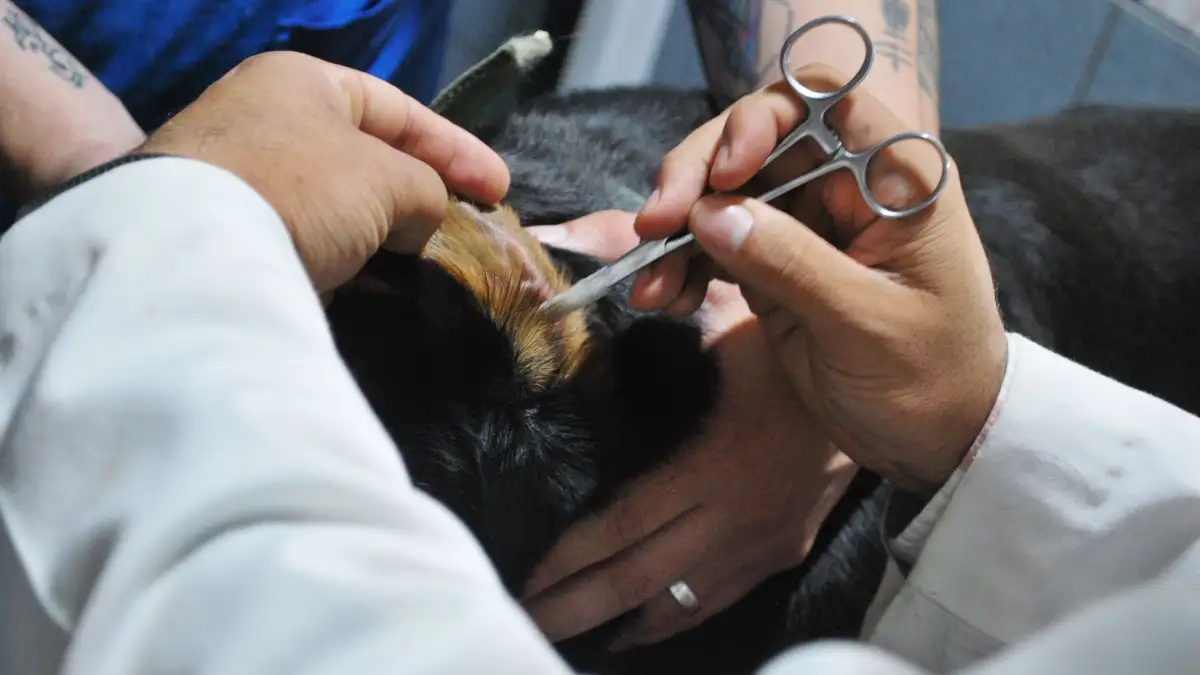
Trimming a black dog nail without hitting the quick comes down to one habit: never take a slice you haven't earned. You cut a thin disc off the tip, wipe the dust off the fresh cut face, and look at it under a bright, close light. On a black nail that cut face is the only place the quick ever becomes visible, because the pigment blocks light from the side. When a gray or pink dot shows up in the middle of that surface, you have reached living tissue, and you stop. The nail is short enough for another two weeks, and nobody bled.
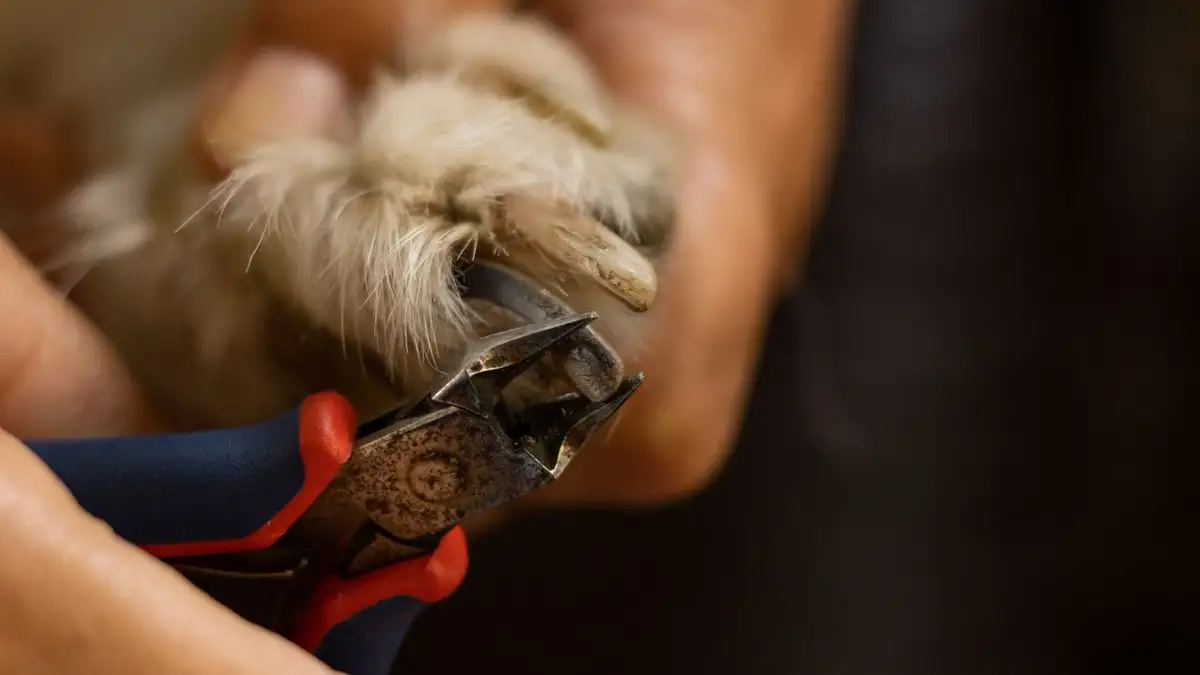
That's the whole method, and it took me a few years and one very bad Sunday to trust it.
The quick is a finger inside a sleeve
The quick is not a cavity or a channel running down the middle of the nail. It's living tissue — blood vessels and nerves sitting over the last bone of the toe — and the keratin shell grows around it the way a sleeve wraps an arm. It tapers as it goes: thick and wide down at the base, narrowing to almost nothing at the tip. That geometry is why the tip of the nail is always the safe part, and why every bit of the risk lives near the base.
On a clear or light nail, you can see it. The pink wedge that ends in a point, visible through the shell. Cut a millimeter or two ahead of that point, parallel to the line, and you're done.
Black nails give you none of that. I have held a black nail directly under a lamp, rotated it, squinted at it, and there is nothing to see. The pigment is the point of the nail, and it stops the light. So on a black nail you don't cut because you already know where the quick is. You cut a little in order to find out.
That changes the arithmetic completely. Every slice has to be small enough that being wrong costs you nothing — a disc thin enough that the worst case is a bead of blood and a dog who forgives you. I call it a slice I can afford to lose.
Setting up to read the cut face
Most bad trims I've seen, including mine, weren't a timing problem. They were a lighting problem.
A black nail face under a kitchen ceiling light looks like a black nail face. Under a lamp pulled down to a foot away and aimed at the tip, it looks like a cross-section — outer shell, dusty center, and a color that shifts as you get closer to the quick. So the setup is: lamp low, dog on something that isn't slippery, my hand under the paw with my thumb on the pad and my fingers across the top. Not squeezed. Just held.
Then the wipe. This is the part I never read anywhere and had to learn from a mess of my own. Keratin dust is pale gray. Cut a black nail and the fresh surface is covered in gray powder, and that powder sits right in the middle of the nail. It looks exactly like the dot you're searching for. If you don't wipe it off, you'll either stop three slices too early for months and wonder why the nails never get short, or you'll panic and quit. Fingertip or a bit of gauze across the cut face. Then look. Then decide.
A clean cut matters too. The clipper should take one firm, complete squeeze and drop a solid disc. A half squeeze, or a twist, leaves a crushed ragged edge that reads white and torn, and you can't tell what you're looking at. If a thick nail cracks instead of cutting, that's information about the tool, not the dog — thick nails want a larger clipper or a grinder, not more force.
The sliver routine
The sequence, as I actually run it: wipe the face. Look. If it's dry, chalky black all the way across, cut one thin disc. Wipe again immediately. Look again.
The change you're watching for is subtle before it's obvious. Far from the quick, the center is dry and matte. Closer, it starts to look faintly waxy, a little paler, like the surface of a candle. Then the dot appears — gray, or pink, or a blend of the two, sitting in the middle of the cut face and ringed by the darker shell. That's the edge. Stop, treat, put the clipper down.
Two slices, then a full stop and look. Not three. Two is a habit. Three is a guess.
And one hard rule sits on top of it: if I can't see the face — dog wiggling, light bad, dust everywhere — I don't cut. I put the paw down. Nails don't have to be finished in one sitting, and a half-trimmed nail is not an emergency. There is no version of this where cutting blind works out.
When the nail already clicks on the floor
The test isn't walking. It's standing. A dog standing still on a hard floor with nails tapping the surface has nails longer than the paw wants. And it isn't only noise. A nail long enough to contact the floor is levering the toe up with every step, which changes how the foot lands. The click is the audible part; the altered gait is the part that matters.
Most dogs need a trim every two to four weeks. Two things bend that number. Wear: dogs who do real mileage on pavement or gravel, or on rough concrete in a yard, grind their own nails down, usually the back ones fastest. No wear: dewclaws don't touch the ground at all, so they only get shorter if you shorten them. I've known dogs whose back nails needed attention twice as often as the front, and dogs whose back nails never needed anything.
If the nails have gone a long time untouched, the quick has grown down with them. It does recede again under regular small trims — I've watched that happen over months on a dog I took on from someone who never touched his nails. But recede is slow, and it happens on a schedule of every ten days to two weeks, not in one heroic session.
Clipper or grinder
These are two techniques, not two brands. A clipper takes a bite: fast, quiet, and it leaves a flat face that's easy to read, which is why I still use one on black nails. It also crushes brittle or thick nails, and it can remove more than you meant in a single squeeze.
A grinder removes dust a little at a time and leaves a rounded tip, which is easier on floors and on skin. It also builds heat, so a few seconds per nail is the limit before you move to the next one — and the heat arrives before the color does. A nail can get warm enough to bother a dog before the tip looks short. Some dogs hate the vibration; some hate the squeeze. You can't predict which from looking at the dog. Thick nails push me toward the grinder. Thin, brittle nails, or a dog who won't hold still for the noise, push me back to the clipper.
The dog who can't do ten nails
One nail is a complete session. That's the entire adjustment. Trim one nail, hand over something high value, put the clipper away, done. Tomorrow, another one.
I know how absurd that sounds if you've been trying to get through four paws at once. But a dog who panics at nail two and spends the rest of the session thrashing isn't learning that nail three is survivable. A dog who gets one nail and a piece of cheese is learning that the clipper comes out and nothing bad happens. Ten short sessions across ten days is not slower than ten minutes of wrestling, and only one of those leaves you with a dog you can still handle in six months.
The other half is paw handling with no clipper in the room. Hold a paw while you're watching TV, spread the toes, look at the nail, let go. No treat needed, no goal. That's what makes the real session boring, and boring is the target.
If you do nick it
Stay quiet and stay put. A dog reads panic faster than it reads pain, and a dog that bolts with a bleeding nail paints the floor.
Firm, steady pressure with a clean cloth or gauze right on the tip, and hold it — a few minutes, without lifting to peek every fifteen seconds. Most nicks stop. If it doesn't stop, or it's still bleeding after sustained pressure, that's a call to your vet rather than something to keep working on at home.
The next day, start again with one nail and stop early. A dog's memory of the bad one fades fast when the next one ends well.