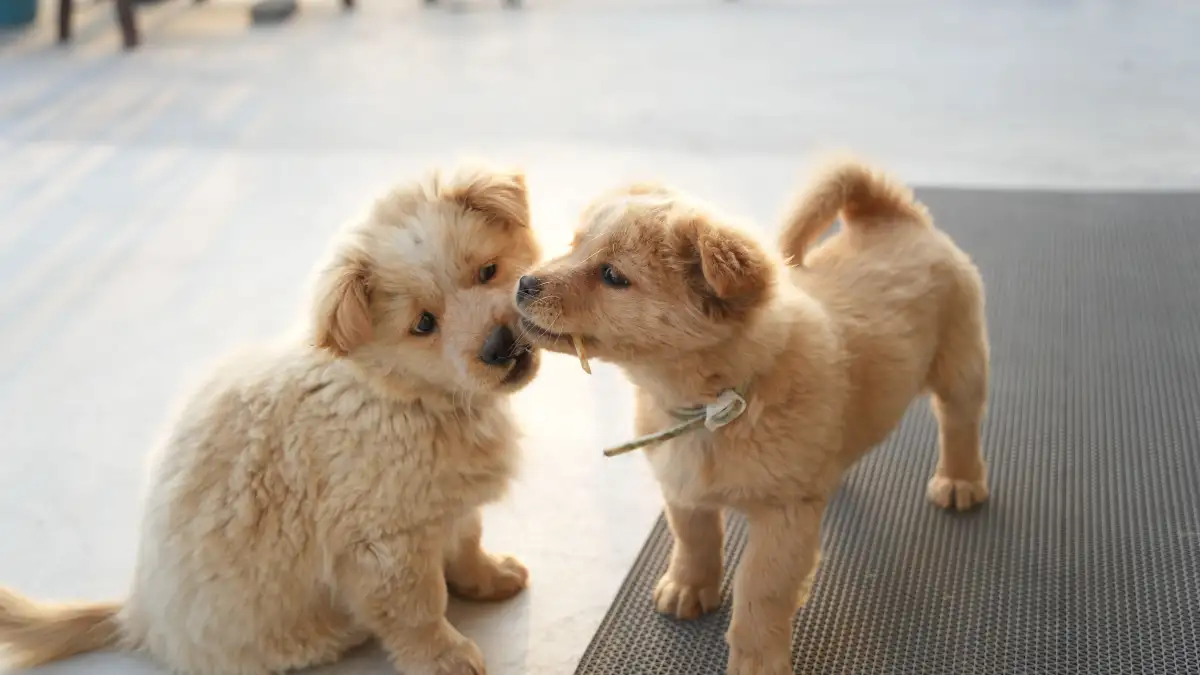
You do not introduce a puppy to a household. You introduce it to three separate household members — the child, the cat, and the dog who already lives there — and each one needs its own protocol, its own pace, and its own escape route. Three parallel projects, running at the same time, in the same house. The families who get into trouble are almost always the ones who turn the first week into one long "meet everybody" event, because the rules that keep a six-year-old safe are not the rules that keep a cat sane, and neither of those is the rule that keeps the resident dog comfortable.

I figured that out standing in a hallway.
Our last puppy was nine weeks old and small enough to walk under the coffee table without ducking. It was the second evening he was home. My daughter was on the living room rug, sitting the way we'd practiced, and then leaning forward with both hands out anyway, because she is six and sitting still is a big ask. The cat was up on the back of the couch — not somewhere she goes — staring down at the puppy with her ears turned sideways. And our older dog was standing in the kitchen doorway. Not growling. Not wagging. Just standing, watching, and I have lived with that dog long enough to know that stance. That is the stance he gets right before he makes a decision.
Three animals, three completely different problems, and one of me.
Before that night I had been treating it as a single job: introduce puppy to family. It isn't one job. The child protocol runs on the child's attention span and impulse control. The cat protocol runs on the cat's territory and the cat's terms. The resident dog protocol runs on a tolerance level he spent years establishing and can lose in one bad afternoon. Different clocks. So the setups have to be different too.
The child: the fastest clock, and the shortest leash
Sitting on the floor with hands in the lap is the whole greeting. Not reaching over the puppy's head, not scooping him up, not the leaning-over hug every kid wants to do. A hand coming down from above reads to a puppy as a grab. A kid sitting on the floor puts a face and two hands at puppy height, and the puppy gets to decide whether to close the last two feet. That choice is the part that matters. When the puppy is the one who approaches, the interaction starts on a completely different footing than when he's cornered by an eager kid.
An adult in the room, every single time, for the first few weeks. Not because your kid is bad with animals — because a nine-week-old puppy has no brakes. He's all mouth and no judgment, and even a gentle child can end up with a puppy tooth against a cheek simply because the puppy got excited.
Keep it short. Five minutes, three times a day, is worth more than one long session. And the ending matters as much as the greeting: when the puppy walks away, the interaction is over. That isn't rejection, it's the off switch. If you let the kid follow the puppy and carry him back to keep playing, you have just taught both of them that the puppy's version of "no" doesn't count. That lesson is very hard to un-teach later.
The first week, I usually sit on the floor between them. Not hovering over the kid, just there.
The cat does not get introduced. She gets a territory.
This is the part most people get wrong, and they get it wrong at the setup stage, before the puppy has ever met the cat.
Cats don't do greetings. They do space. So the whole cat protocol is about making sure the cat's world does not shrink when the puppy arrives. Before the puppy is loose in the living room, the cat needs a way up and a way out. Up means vertical — a cat tree, the top of a bookcase, a shelf she can reach in one jump that the puppy cannot. Out means a room the puppy can't enter, with a gate the cat can slip or hop but the puppy can't, and behind that gate the litter box, the food, the water, and a bed. If the cat's eating, sleeping, and hiding spots all get moved because of a puppy, she will eventually take it out on the puppy, or on your carpet, or on the back of a closet door for a month.
Introductions happen at distance. Puppy on a leash, held or tethered at one end of the room. Cat loose and free to leave. No carrying the puppy up to the cat. No holding the cat up to the puppy. No nose-to-nose. If the cat walks out of the room, nothing has gone wrong — the system just worked. That counts as a successful interaction.
The timeline is the cat's, not yours. I've had a cat settle in about a week, and I've had one who took the better part of a year, and the difference had almost nothing to do with the dog. Same household rules, same patience, wildly different clocks. Trying to rush a cat is the one move guaranteed to add months.
The resident dog: neutral ground, then a lot of walking
The first meeting goes better outside the house. A sidewalk, a quiet street, a fenced yard neither dog has claimed as his own. Not the living room. The living room is your dog's map — he knows every corner and every smell in it — and a strange puppy on his rug is a much bigger deal than a strange puppy on concrete.
Both dogs on leash. Walk them parallel, far enough apart that each one can look at the other and then look away. That look-away is the entire goal. A dog who can glance at the puppy and then go back to sniffing a fire hydrant is telling you he's fine right now. A dog who can't look away, who locks on and stays locked, is telling you the distance is too small. Move out, don't correct.
Then days of short parallel walks. Same direction, side by side, with space between. No greeting, no sniffing, no stopping. You are teaching both of them the same thing: the other one exists, the other one is boring, nothing bad happens when the other one is nearby.
Then a brief on-leash hello in the yard. Ten or fifteen seconds, then walk away while it's still calm. Then more walks. Off-leash time comes after weeks, not days, and it comes in a space where you can see both of them and step between them if you need to.
The resident dog sets the speed. Not the puppy, who wants to play, and not you, who wants the photo of them curled up together.
Where all three protocols overlap
Two things cut across all three introductions.
The first is resources. Bowls in separate rooms, or one in the kitchen and one in a crate, so nobody has to eat near anybody. Beds in different rooms, not side by side in the same corner. Chews only when they're separated or when you're sitting right there. Toys picked up when play is over. A puppy who has to compete for anything at all learns to guard, and guarding starts quietly — a body going stiff over a bone, a step over a bed, a hard stare at the cat's dish. You want to never see the first version of it.
The second is the measure of progress, and it isn't what people expect. It isn't play. It isn't how fast you get everyone into one room. It's calm proximity over time. Two dogs lying on the floor in the same room ignoring each other is a better sign than two dogs wrestling in the first week. A cat crossing the room while the puppy watches from his bed and stays put is a milestone. A kid and a puppy on the same floor with nobody holding anybody and nobody leaning toward anybody — that's the picture you're building toward. Nothing about it looks exciting.
It depends, too. An older dog with sore hips is not the same project as a young, sturdy one. A cat who has never lived with a dog may need a much longer runway than one who has. A two-year-old can't follow the sit-and-wait rule at all, so the gate stays up longer, sometimes months longer. And some households end up with a puppy and an older dog who coexist politely for years without ever becoming friends, which is a perfectly good outcome.
What I watch for now
Nobody hands out medals for speed. The families I know who got through this well were boring about it. They left the gate up past the point where they wanted to take it down. They ended good interactions early, while everything was still calm, instead of waiting for the moment things tipped and then reacting. Their puppy never had to find out what happens when he pushes.
The night it clicked for us, our older dog walked past the puppy to get to the water bowl and didn't even glance down. Nobody was holding anything. The kid was on the couch. The cat was asleep on the back of a chair. That was it. No big moment. Just a house where three separate introductions had finally gone quiet at the same time.