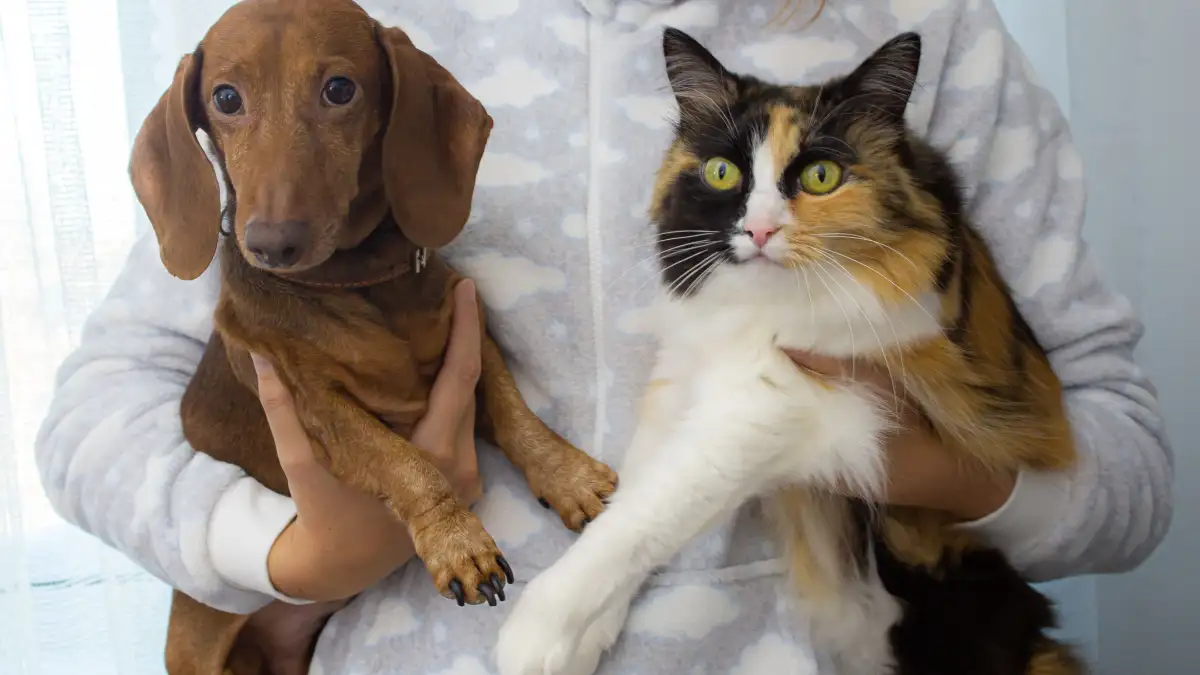
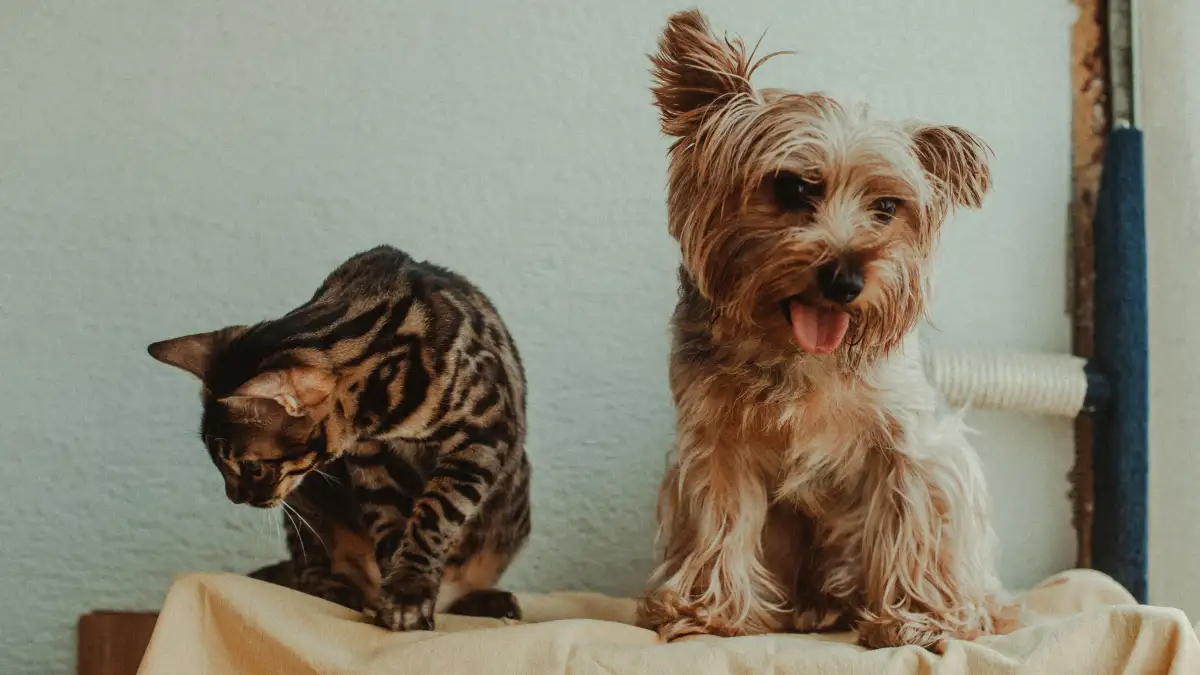
A calm first meeting between a dog and a cat is not a moment you manage, it is a position you build before the cat ever comes through the door. The dog holds a mat on a loose leash with its attention still available, the cat keeps an open route back to a dog-free room, and the actual face-to-face runs one to three minutes, ending sooner if the dog's head locks onto the cat and stops moving.
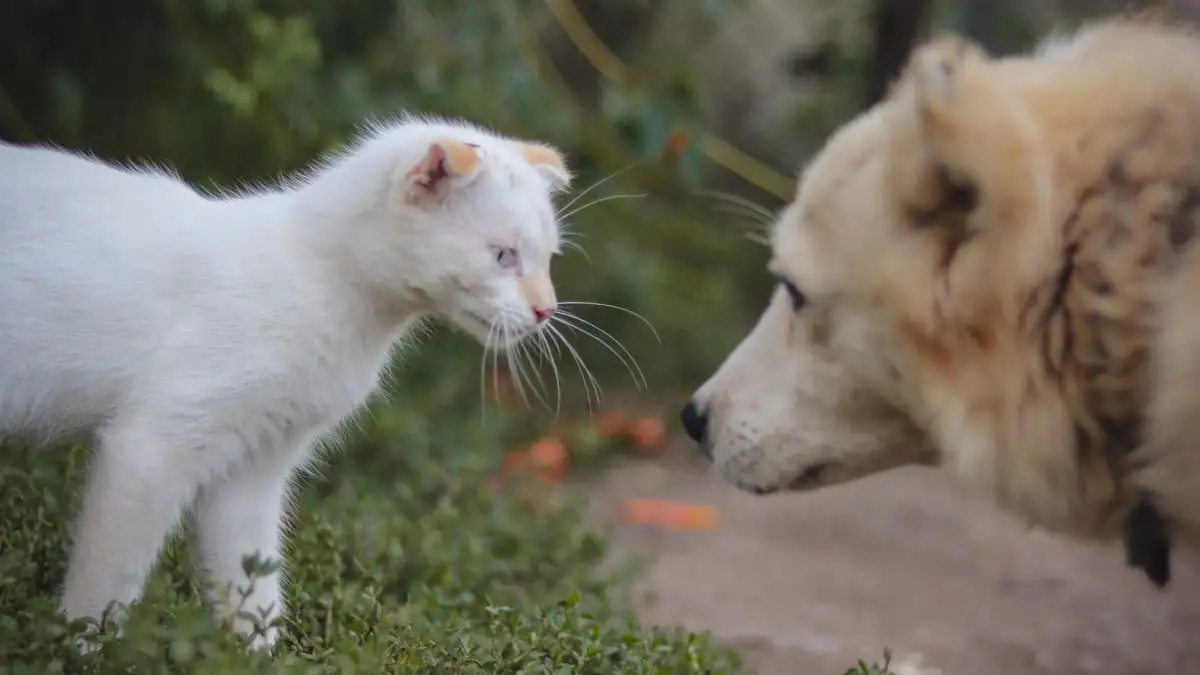
I figured that out the hard way, standing in my own hallway with a leash wound twice around my hand and a dog who had already decided the whole thing was a chase. What I got wrong wasn't the meeting. It was the ten minutes before it. I opened the door because both animals seemed calm, and calm in a quiet house is not the same thing as ready. A dog that is relaxed with nothing to look at has not practiced being relaxed with a cat in the room.
So now I do it in a different order, and the order is the entire trick.
The ten minutes before the door opens
I set the mat down first. A flat bed, a bath mat, anything with edges the dog can find with its feet. Not a spot on the couch, not the middle of the open floor. It needs a boundary, because a boundary gives the dog something to do that isn't watching the door.
Then the leash. Not tight. Clipped to a flat collar or a harness, running to my hand with a visible droop in the middle. If the line from my hand to the dog is straight, I'm already pulling, and a dog that feels a pull leans into it. Slack is information. Tension is a decision I made on the dog's behalf, and it's usually the wrong one. On days when I'm working alone, I sometimes use a light drag line instead of holding a leash, a thin line clipped to the harness and left to trail while we practice on the mat. That's for the practice phase only. Once the cat is in the room, the leash is in my hand.
Then I just stand there. The gate stays shut. The cat is somewhere else in the house, doing whatever cats do.
This is where most people quit, because nothing is happening. The dog wanders, sniffs the mat, sits, gets up, sighs. Every time its feet land on the mat, a treat appears between its front paws. Placed, not thrown. Low, not at chest height. If I toss food across the room, I've taught the dog to leave the mat. If I hand it over high, I've taught it to jump for it. Placed and low, so the head goes down instead of up.
A dog is ready when it can lie down on that mat with its chin near the floor while I stand at the end of a slack leash and the room is quiet. That's the test. It isn't obedience. It's a resting position with a job attached.
What I watch instead of the clock
I don't time this part. I watch three things.
The leash. Is there still slack? A dog can be lying down perfectly and still be loading up. The leash shows me where the weight is going before the body does.
The head. Is the dog scanning the room, or is it oriented at the gate? Scanning is fine. Oriented means the dog has assigned itself a job, and the job is the door.
The ears and the shoulders. Ears forward and stiff, weight shifted onto the front legs, that's a dog about to move. Ears loose, one hip cocked, that's a dog that could stay for a while.
When I get the third one, I don't push for a fourth repetition. I stop while it's good. Quitting early on the mat is the whole reason the meeting later goes well. Tired dog, tired handler, no slack left in either of us, and the cat walks in and it falls apart.
The cat's side of the room
Before the gate moves, the cat needs an exit that does not pass the dog.
This is the part people skip because they're so focused on the dog. The cat didn't agree to any of this. A cat cornered in a living room does what a cornered cat does, and that's how you end up with a cat under the bed for three weeks and a dog that has learned cats are something to chase.
So the cat's side needs a clear line to a hallway, a cat tree with real height, a baby gate with a gap at the bottom a cat can slip through, or a door propped open far enough for a cat to walk through but not wide enough for the dog. I've used all four, sometimes at the same time. The cat has to be able to leave whenever it wants, and it has to know it can, which means the route needs to be obvious to a cat that is busy watching a dog.
If there's a second person in the house, this is where they earn their keep. One person manages the leash. The other person watches the cat and does nothing else. Doesn't hold it, doesn't pet it, doesn't soothe it. Just watches the cat's tail and ears and reports. A cat being held during a first meeting is a cat that can't leave, and a cat that can't leave is a cat that will fight.
Opening the barrier
Here's the moment. The gap widens, or the gate comes down, and the cat walks in.
Most dogs look. That's fine. Looking isn't the problem.
The problem is what happens next. If the dog looks at the cat and then turns its head back to me, to the mat, to the treat hand, that's a dog that made a decision instead of a reflex. That's what I mark and pay. Every single time. Look at the cat, look back, treat lands on the mat. Look at the cat, look back, treat. I'm not paying the dog for ignoring the cat. I'm paying it for the round trip.
If the dog looks at the cat and doesn't look back, head down, eyes fixed, body still, weight forward, the barrier goes back up. Not with a yank. I step into the leash line and walk the dog back to the mat, or I close the gate and reset. That isn't a punishment and I don't say a word about it. It's a redo. The dog didn't fail. I opened the door too soon.
There's a third thing that happens, and it's the one I didn't expect the first time. The dog looks at the cat, looks back at me, then looks at the cat again and holds there for a beat. Two looks, one check-in. I'll take that. The check-in is the habit I'm building, coming back to me instead of committing to the cat. If I only reward a full head turn away from the cat, I'll be standing there forever and the dog will learn nothing.
Ending it before it ends itself
The session is over at one to three minutes, or the moment the dog's head stays turned at the cat and stops moving. Whichever comes first. Both are hard stops, and the second one isn't negotiable.
I don't wait for the lunge. I don't wait for the growl. I don't wait to see whether the dog settles. A dog that has gone still and fixed has already made the decision, and the only thing left is the delivery. I'd rather end on a dog that looked away.
So I praise, unclip the leash or keep it on, and walk the dog out to a different room. Different room, every time, for the first several sessions. Not the same room with the cat still in it, because then the end of the good part means the cat is still there and I'm the one who took the fun away. Different room, a chew, a few minutes of nothing.
Then we do it again the next day. Same mat, same leash, same order.
The thing that actually decides whether this works
It isn't the dog's temperament, and it isn't the cat's. Both matter. I'm not going to pretend a high-drive herding breed and a bold cat are the same setup as a sleepy senior and a shy cat. Some pairs need weeks of gate-only meetings with the barrier never coming down, and a few pairs need a behavior consultant in the room. That's real, and no technique erases it.
What I control is the order. Mat first, leash slack, cat's exit open, one to three minutes, out. Every failure I've had came from skipping the order. From opening the door because the dog seemed fine, because the dog had been fine yesterday, because I wanted it to be done.
A dog that meets a cat on a mat, on a loose leash, for ninety seconds, and gets walked out while it's still calm, is a dog that will do it again tomorrow. That's all the first meeting has to be.