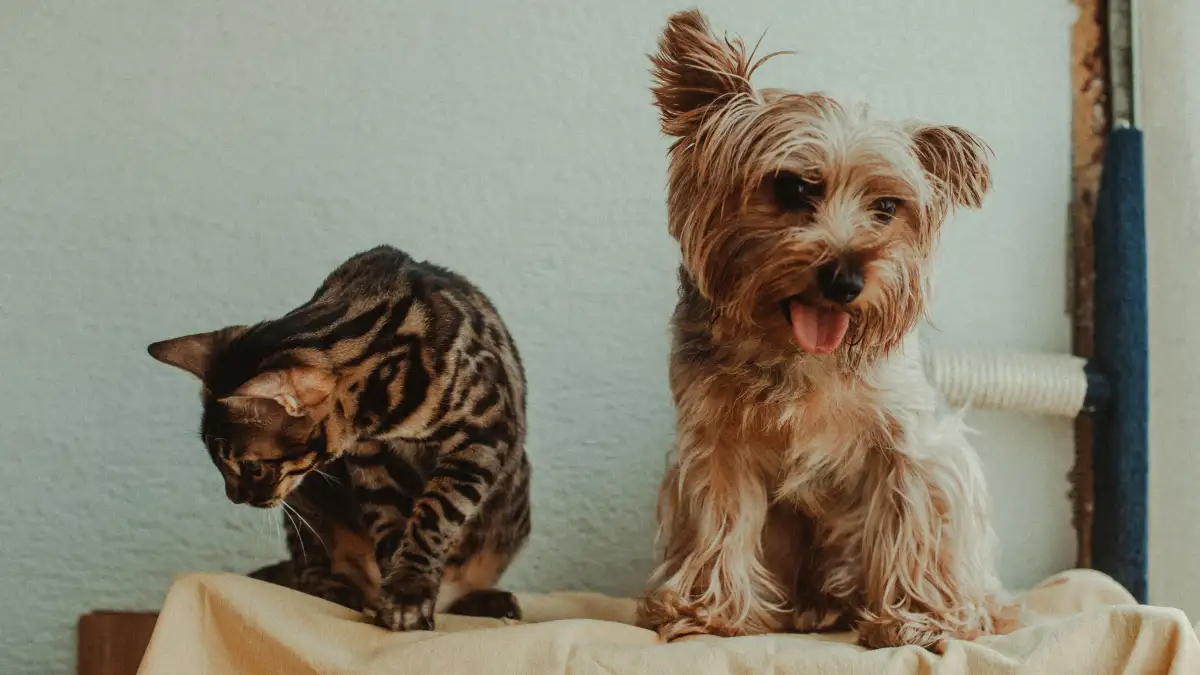
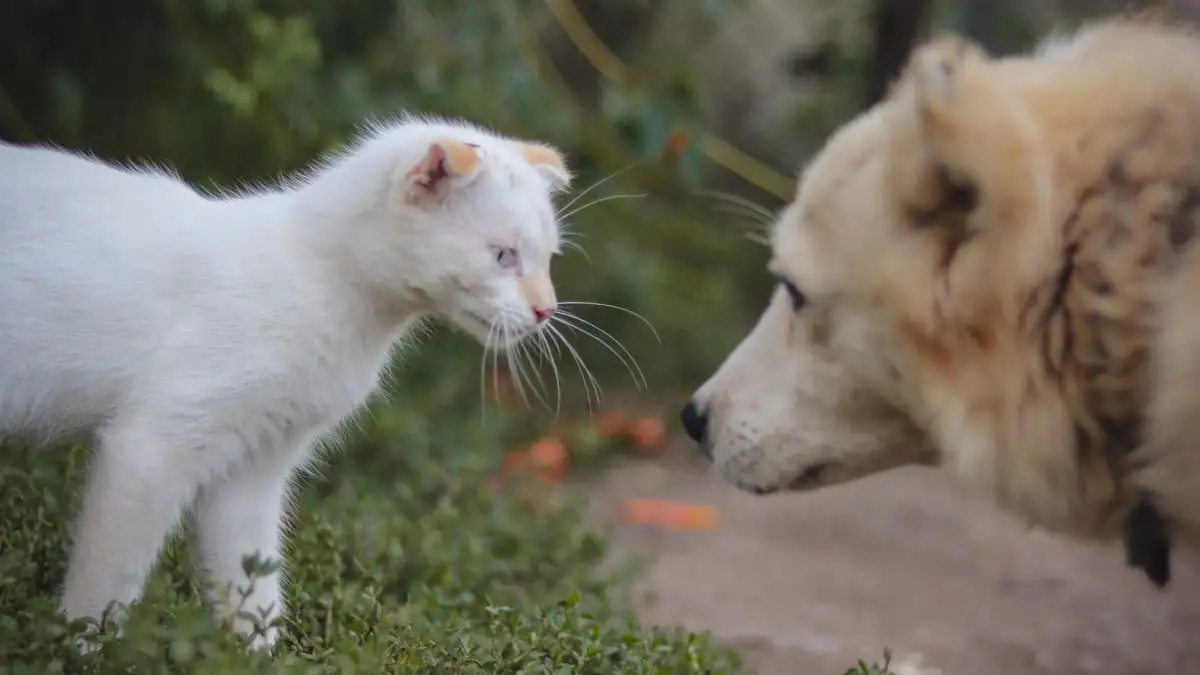
You introduce a dog to a cat in stages, not in one meeting. Scent through a closed door. Then sight through a gate. Then short same-room sessions with the dog on a leash. Then ordinary life in a shared house. You advance only when the cat is still eating, still moving, and still coming out in the open with the dog on the other side of the barrier. Two things stay in place the whole time: the leash on the dog and an exit for the cat. Lose either one and you are not introducing anything. You are just hoping.
I learned this the boring way, which is the only way it sticks. The first night I brought a dog home, I did what most people do. I opened the crate in the living room and let everybody figure it out. The cat went on top of the bookshelf and stayed there for nine hours. I spent the next three weeks rebuilding trust I threw away in four seconds.
The room decides before the animals do
What I check first is layout. Not the animals. The layout.
Where can the cat be, and where can the cat go? If the answer to the second part is anywhere near the dog, the room is wrong. I want a gate the cat can clear in one jump, a hallway with a second door, a couch the cat can get on top of. I want the cat's path to the litter box and the food bowl to run nowhere near where the dog is parked.
The dog gets the opposite arrangement. A short leash, a mat, and me on the other end of it. The leash is not a punishment and it is not a correction tool. It is a brake. It exists so the distance between the two animals is something I control, not something the dog's mood controls. If the leash is clipped to a collar and my hand is at the end, the dog cannot close that gap no matter how fast the decision happens.
I set this up before the dog ever sees the cat. That is the part people skip. They build the barrier after the first lunge.
Stage one: nose only
For the first stretch, the two animals never see each other. The dog is on one side of a closed door, the cat is on the other. That is the whole exercise.
I feed both of them at those doors. Cat bowl on the cat's side, dog bowl on the dog's side, doors shut, and I stand where I can hear. Then I pay attention to the cat, not to the calendar.
The signal I watch for is simple. Does the cat eat, and then does it walk away from the bowl instead of crouching over it? A cat that eats with its head up, listening, is not relaxed. A cat that finishes, licks a paw, and strolls off has told me the door smells like nothing worth worrying about.
I also swap bedding during this stage. A towel each animal has slept on goes to the other side of the door. Sounds fussy. It is not. It lets the smell become furniture before it becomes an animal.
Some people run this stage for two days. I have run it for twelve. It depends entirely on the cat, and the cat is not on my schedule.
Stage two: eyes, not bodies
Now the door opens, but only with a gate or a screen in it.
The dog is leashed. Always leashed. I sit on the floor with the dog, treats in one pocket, my other hand on the leash. The cat is loose on the other side with a clear route to two exits. The cat does not get carried, held, or handed to anybody. If you pick up a nervous cat to show it to a dog, you have just removed the only thing the cat was using to feel safe, and you have created a small projectile.
What I do in this stage is not much, on purpose. I let the dog look. I wait. The second the dog's head turns away from the gate on its own, I mark it and pay it. Not when the dog stares. When the dog looks away. That is the behavior I am buying for the rest of this animal's life.
The cat sets the pace here. Some cats walk right up to the gate in a day. Some watch from under the coffee table for a week. Both are fine. Both tell me what the next step is.
Two things end a session early. If the cat freezes and stops moving, or if the dog cannot stop staring and cannot be redirected, I put a towel over the gate and we are done. That is not a failure. That is a stage that has not finished cooking.
Stage three: same room, briefly
Only when the cat is coming out on its own and the dog is disengaging when I ask do I try the same room.
Short. Two minutes. Sometimes less. Dog on leash, parked on the mat, and I sit between the two of them rather than beside one. The cat gets the run of the room. If the cat walks past the dog at a normal pace with its tail up, that is a pass. If the cat walks past and the dog does not launch, that is a much bigger pass.
I do not reward the greeting. I reward the not-greeting. Nose to nose is not the goal here. A dog that turns its head away, drops a shoulder, sniffs the floor instead of the cat, is doing the exact job I want, and that is what gets the food.
Then I end it while it is going well. That is the hardest part, honestly. People keep going because it feels like a success, and the good moment turns into the moment the cat gets chased.
One good session means almost nothing. It could be a cat too surprised to react and a dog too tired to care. What I look for is repetition: three or four short sessions in a row where nobody froze, nobody hid, nobody snapped, and the dog came through the leash-and-mat routine without tension. If I get one bad rep in the middle, I do not count the whole set. I go back a step and rebuild it.
That is what regression is. Information. It is not the cat being dramatic or the dog being stubborn. It means I moved faster than one of them could handle, and the fix is a backward step, not a correction.
The stage everybody quits too early
This is the one I would underline.
Sleep, meals, and the hours nobody is home stay separated for a long time. Longer than feels necessary. I do not care if the two animals are napping on the same couch. If I leave the house, the dog goes to its own space and the cat has the rest of it. If it is feeding time, they eat in different rooms.
Roommates who like each other still get their own rooms. The reason is that the person watching is the whole safety system at this point, and when the person leaves, the system is gone. Behavior that looks settled in front of somebody can look completely different when nobody is watching.
The bar for ending that separation is not "they get along." It is "they ignore each other, repeatedly, for multiple days." Ignoring is the finish line for me. Friendship is a bonus that sometimes shows up later and often does not, and that is fine.
What calm actually looks like
People ask me what to watch for and I think they expect something dramatic. It is the opposite.
A relaxed cat moves at a normal pace, holds its tail up or level, eats, and uses the room. A cat that is not relaxed stops mid-step, holds low, goes quiet, or finds a high place and stays. That last one is easy to miss, because a hiding cat looks like an easygoing cat. It is not. A cat that never comes out is a cat that has lost its territory, and that is the outcome I am trying to avoid.
A dog that is settled has soft eyes, a loose mouth, ears that are not locked forward, and the ability to break off and look at me when its name is said. A dog that is not settled is stiff, staring, silent, and leaning forward. Silent is a warning, not a sign of progress. Barking and lunging are loud, but at least they are readable.
Reward the quiet ones. The head turn, the weight shift back, the lie-down, the sigh. That is the behavior that carries the whole thing.
When to stop and get help
This process does not guarantee anything. Animals are animals, size differences are real, and prey drive is real. If a bite breaks skin, or if a cat stops eating or starts hiding around the clock, that is a veterinarian conversation, not a training-tweak conversation. Call your vet.
If the dog cannot be redirected at all, or the cat has not settled after weeks of careful staging, a certified trainer or behavior consultant who works with multi-pet households is worth the money. Some pairs need a professional set of eyes in the room. That is not a personal failing.
I have run this sequence with a mellow older dog and a cat who could not have cared less. I have also run it with a young dog who needed four months before the cat would walk through the living room while he was awake. Different animals, same four gates. Scent. Sight. Short same-room. Ordinary life. The cat moves the gate forward. The leash keeps the dog from moving it early.