When an older dog starts barking at night, the first thing a veterinarian checks is not behavior. It is pain and the senses. A dog in the last third of life who suddenly barks at 3 a.m. is more often hurting, or working with less vision and hearing than they had a year ago, than deliberately causing trouble. That is why the most useful thing an owner can bring to the appointment is not a training question but a written log — the time it starts, the room, the direction the dog is facing, how long it lasts. Everything you can fix at home comes second: a night light on the route to the door, non-slip rugs over hard flooring, a bed that is easy to step into, and a sleeping spot where the dog can still hear or see you.
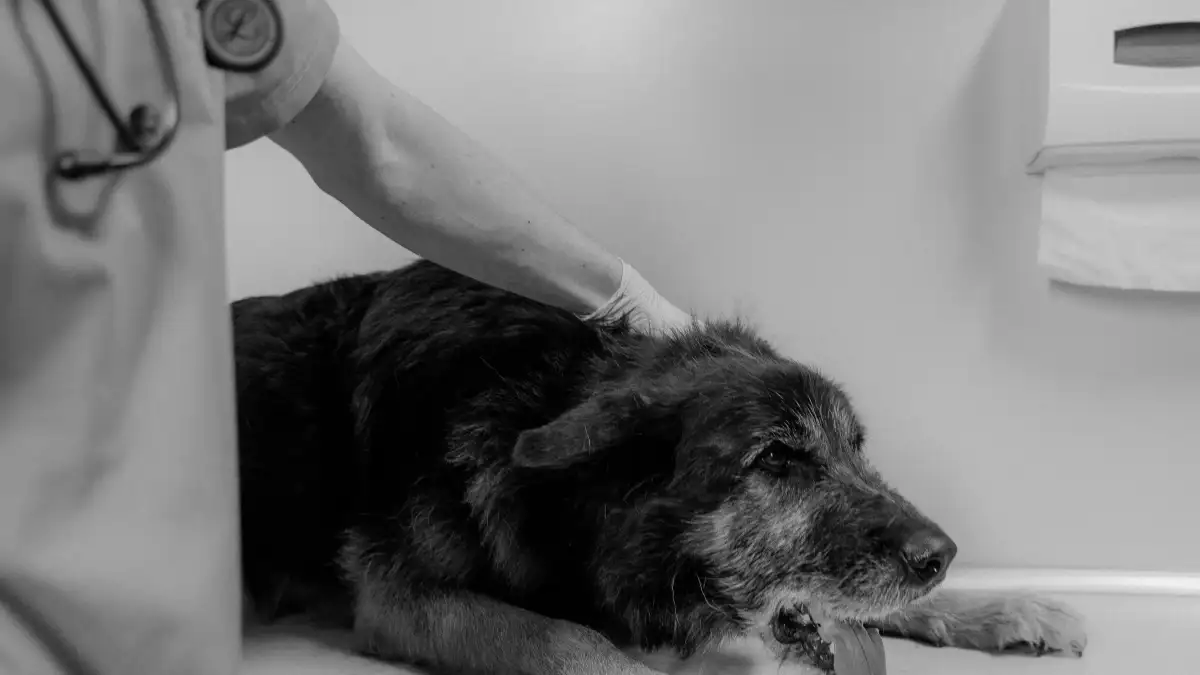
The first night it happened here, I was standing in the hallway at 3:10 in the morning with my feet on cold laminate, one hand flat against the wall, watching an old dog stand in the corner of the living room and bark at the west wall. Not the front door. Not the window. The wall. He would stop, turn, take four or five stiff steps, and start again. So I did what everyone does. I let him out. He walked to the middle of the yard, stood with his nose down for a while, and came back in. Water bowl. Lie down. Forty minutes later we ran the whole loop again.
By the fifth night I had stopped being patient and started being a record keeper, because I could already feel how this was going to go at the clinic. I would say "he's up barking a lot at night," and the vet would nod and move on, and we would both leave that room with nothing.
Three columns on the back of an envelope
I taped an envelope to the fridge and wrote three things every time it happened: the time, the room, and how many minutes. Then I added two more because they turned out to matter. Which direction he was facing. And whether he looked at me when I said his name.
That's the whole system. It takes ten seconds at 3 a.m. and it changes the conversation completely.
"Barks at night a lot" is not information a veterinarian can do anything with. "Between 2:30 and 3:15, standing in the kitchen corner, facing the wall, three nights out of five, doesn't turn when I say his name, settles after about twenty minutes if I sit on the floor with him" — that's a different appointment. That gives the vet a pattern to work against instead of a shrug.
I also started taking a twenty-second video on my phone. Just the dog, the room, the sound. You will not be able to describe the bark accurately later, and it turns out the bark is part of what they're listening for. Do it while it's happening, not after. Night mode, low light, don't turn on the overheads.
The part that's mine to fix
Here's the split I keep coming back to: some of this is environmental, and some of it is medical, and the two look almost identical from the doorway at 3 a.m. I can't tell them apart from here. But I can fix my half first, cheaply, and see what's left over. What's left over goes in the appointment.
Light. Not an overhead light. Two plug-in night lights, ankle height: one where he turns at the top of the stairs, one by the back door. Old eyes need more contrast and less glare. A dark house that used to be navigable becomes a series of black doorways.
Floor. Cheap non-slip mats, three of them, placed at the turn points — top of the stairs, beside the bed, in front of the door. Not wall to wall. Just the spots where a dog pivots, because a pivot on slick hardwood is where the hesitation starts.
Bed. He had a deep bolstered bed he had to climb out of. We swapped it for something he can walk into. An old dog getting up six times a night is making that decision every time, and a bed that's a wall to climb over is a poor trade for the look of it.
Warmth. Older dogs run cold. His bed had drifted under a drafty window because that's where it always was. It moved to a spot away from the draft, closer to the warm side of the room.
None of this is dramatic. All of it is the difference between a dog who can get up, cross the room, and come back without an ordeal, and a dog who has a reason to stand in a corner and bark.
The last trip outside is timed wrong in most houses
Two numbers decide your night: when the last meal lands, and when the last break happens. If dinner is at six-thirty and the last out is at seven-forty-five, you have built yourself a 2 a.m. wake-up and you'll be confused about why it's always the same time.
What worked here was moving the last meal earlier and the last out later, with enough space between them that digestion was underway before lights-out. And then changing one more thing: I stopped opening the back door and letting him sort it out alone. An old dog takes longer to get into position, and a dog who's stiff is not going to do a full lap of the yard looking for the right spot. I walk him to the far corner on a leash, stand there, give him the time, and bring him back in. Low light. No talking, no play. Boring on purpose, because the goal is to make the trip forgettable.
Where the bed sits
This is the one I'd move first if I had to pick one.
As hearing and vision fade, proximity starts doing the work that eyes and ears used to do. The dog checks the world by smelling you and hearing you move. A bed in the laundry room, which was fine for eight years, stops being fine. I put his bed on my side of the bedroom, where he could hear me breathing and hear the floor creak when I got up. The 3 a.m. barking went from nightly to occasional within a week — not because anything was cured, but because he stopped having to check whether he was alone.
And do not rearrange the furniture. This is the one people do without thinking, usually while the dog is at a groomer or a vet visit. Older dogs navigate from a map they built over years, and the map does not update quickly. I moved one chair four feet while he was asleep in the other room. That night he walked into the empty space where it used to be, stood still, and barked at it. I moved it back. The barking stopped.
I'm not saying every night bark is a moved chair. I'm saying try undoing the change first, because it costs nothing and it's the fastest thing to rule out.
What doesn't belong in the living room
A night light and a rug and an earlier dinner will help a dog who is confused by the dark or sore on a slick floor. They will do nothing for the list below. If you see these — especially if they arrive suddenly rather than drifting in over months — that's an appointment, not another adjustment at home.
- Barking at nothing at roughly the same hour, night after night, that doesn't stop when a light comes on or when you sit with him.
- Standing and staring at a wall or into a corner while awake and upright.
- Pacing in tight circles, or getting stuck in a corner facing the wall and not backing out.
- Waiting at a closed door, or a blank wall, like it's the door.
- New accidents overnight, or asking to go out far more often after dark.
- Restlessness that doesn't settle even with you right there on the floor next to him.
If you fix the environment and the behavior doesn't budge in a few nights, that isn't a failure. That's the answer, and it belongs in a room with an exam table in it.
What the vet is looking at first
Pain, and the senses. That's the order. An older dog who hurts when they stand, or who has lost enough hearing that the house has gone quiet and strange, has a reason to be up at 3 a.m. that no amount of rug placement is going to touch. This is hands on the hips, hands on the dog, moving joints through a range, watching how he rises from the floor, checking ears and eyes.
I can't tell you from here whether your dog is in pain. I can't tell you what's causing the barking, and I'm not going to guess at it in a paragraph — that's what the appointment is for. Decisions about medication and anything you'd add to the food belong to that exam room, not to a late-night search. Bring the envelope. Bring the video. Say the times out loud.
One more thing worth knowing: some of this is a trade-off, not a fix. If a dog is hard of hearing, they lose the volume knob on their own bark and it gets louder and more frequent — which sounds worse and isn't necessarily worse. A quieter house can make that more obvious. That's not something you solve with a night light.
Do the cheap half first. Log the rest. Then put it in the hands of someone who can actually look at the dog.
The barking isn't the problem. It's the report. You're just the one who has to write it down.