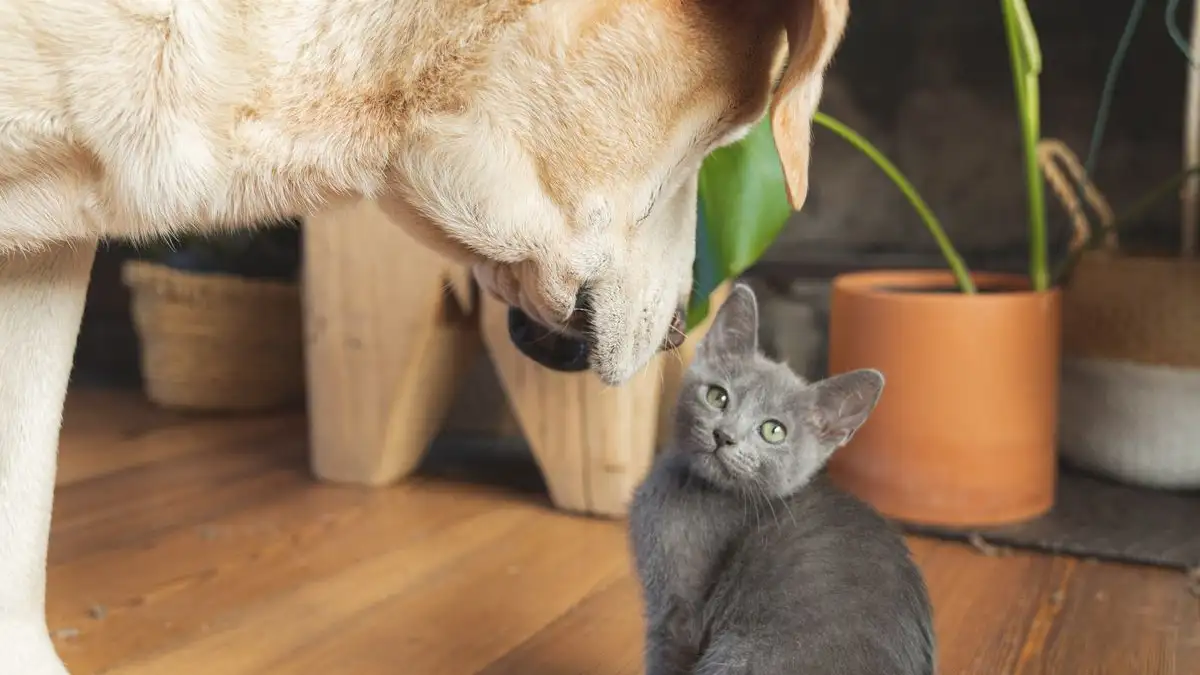
The trait that decides whether a dog can live with cats is how far that dog's predatory sequence runs before it stops — whether the chain that begins with noticing a small animal ends at the stare, the chase, or the grab. Body size and energy level predict almost nothing about this. The second variable belongs to the cat: how much escape room it has, meaning vertical routes, dog-free rooms, and gaps a dog cannot follow through. Compatibility is those two things together, which means the same dog can be a workable housemate in one layout and a genuine danger in another.

I learned it in a hallway at a little past six in the morning, in socks, holding a leash, doing nothing.
The cat was on the third platform of the cat tree with her tail hanging over the edge like a piece of rope. At the other end of the leash was a seventeen-pound terrier mix — small, quiet, unremarkable. She had gone completely still. Not barking, not pulling, not even leaning. Just still, eyes locked on that tail, body held like a breath. I said her name twice in a normal voice and got nothing back.
I had read three lists that week that would have filed a dog like her under easy, because she was small, because she was a mix, because she spent most of the day asleep on a couch. The stillness was telling me something the lists could not. I just did not know yet what to call it.
The chain, and where it stops
Predation in dogs is not one behavior. It is a sequence of behaviors that can each be present or absent: notice, freeze and stare, stalk, chase, grab, shake, kill, eat. Different breeds were shaped for different links in that chain, and the link that matters most in a house with a cat is the one near the end — the grab and the shake.
Terriers were developed for animals that bolt into holes. As a group, the early links got compressed and the grab-and-shake end got emphasized. Sighthounds are close to the opposite: the chase is the loud link, and many of them lose interest the moment the animal stops running. Scent hounds work nose-first; movement triggers pursuit, but the finish is often not there. Retrievers and spaniels were bred to work beside a person, bring things back, and not crush them, so the grab exists but the killing end is usually muted. Most herding breeds were built to move animals without eating them, which leaves a strong stare and a strong chase and a soft finish.
That chase is real, though. A cat sprinting down a hallway looks exactly like the thing a herding dog was built to move.
None of that is a verdict on any breed. It is a probability statement. Two dogs of the same breed, same age, same size, can sit on opposite ends of that chain.
A running cat is the trigger for nearly all of them
This is the part that gets skipped. For most dogs with any chase in them, the trigger is motion, not species. A cat that walks across the living room slowly and sits down is a different stimulus from a cat that breaks into a run. Which is why the cat's side of the equation is not a consolation prize. It is often the deciding factor.
The variable you actually control
I stopped thinking about this as "is this dog safe with cats" and started thinking about it as floor plan. The question I ask now is: can the cat get everywhere it needs to go without touching the floor?
In my house that looks like a few specific things. Cat trees tall enough that the top platform sits above the dog's reach even when the dog jumps. Shelves, and a cleared section of counter, forming a connected path from the living room to the back bedroom so the cat never has to cross open floor. A gate at the bedroom door with a cat-width gap in the bottom corner, so the cat passes and the dog does not. Litter box, food, and water behind that line, permanently.
The dog is crated or gated when nobody is home and when nobody is watching. Not as punishment — as the default arrangement. A dog that is loose and bored and alone with a cat is the version of this problem that ends badly, and crating changes that risk more than breed choice ever will.
Then the small stuff, which is most of it. Doorways. The top of the stairs. The corner where the hallway turns. Those are the places where a cat gets surprised and runs, and a running cat is the trigger. I clear sight lines at those spots, or I block them.
What I watch in a dog, in order
The first thing is the freeze. A dog that goes still and cannot be called off a cat is further along the chain than a dog that barks its head off. Barking is noise. Stillness is aim.
Next, whether the dog can break off. If I hold a piece of food out and the dog turns its head, the chain has a brake in it. If the dog's eyes keep sliding back to the cat while it chews, the brake is weaker. If the dog will not take food at all while the cat is visible, there is no brake in that moment.
Then the smaller signals: trembling, whining under the breath, drooling, a hard stare that does not blink, stiffening when the cat moves. Those are the ones that get discounted, because the dog is quiet and seems well behaved.
And I ask about history. Has this dog lived with a cat? How did that go, specifically — did the cat sleep on the bed with the dog? I take the answer seriously but not as proof, because people frequently do not know, or they remember the good parts.
Why the lists contradict each other
Most breed rankings fold three separate questions into one "good with cats" label: will the dog chase, will the dog grab, and will the dog live calmly around a cat. Those are not the same question and they do not have the same answer. A dog that chases but never grabs is a different household problem from a dog that grabs. A dog that lives calmly but will chase if the cat runs is a third thing. All three get flattened into one label, and since different lists weight those questions differently, they disagree with each other.
The dog that chases and stops is often fine in a house where the cat has a full vertical route. The dog that grabs is not fine in that house, or in most houses. Knowing which one you are looking at matters more than knowing the breed.
What I would tell someone choosing right now
Treat the breed as the starting probability, not the answer, and spend your attention on the adult dog in front of you and on your own floor plan. If the dog is a puppy, assume nothing. The chain shows up as the dog matures, sometimes around a year, sometimes later, and it surprises people who knew the dog as a placid puppy. If the dog is an adult with a history, that history is more informative than anything the breed name carries.
Be honest about the limits. Some dogs cannot safely share a house with a cat, and no amount of shelving fixes it. Some cats will not stop ambushing a dog and will make a calm dog defensive. And there is a version of this that ends with the gate staying up forever and the two animals living parallel lives in the same house — which is a fine outcome, if everyone is honest about it and nobody is getting hurt.
But the decision itself is not a mystery. Watch where the chain stops in the dog. Count how many routes the cat has. Then decide your household from those two things instead of from a list.