Recovery is possible, and the route back is almost always the same one: separate the two animals completely, put a door or a gate between them, and spend the next several weeks rebuilding the introduction through scent, feeding, and short visual sessions that end before anything goes wrong. A first meeting that turned into a lunge or a chase is not proof the pairing can't work. It's proof the introduction moved faster than either animal could absorb, and the correction is to return to the stage where they never see each other at all.
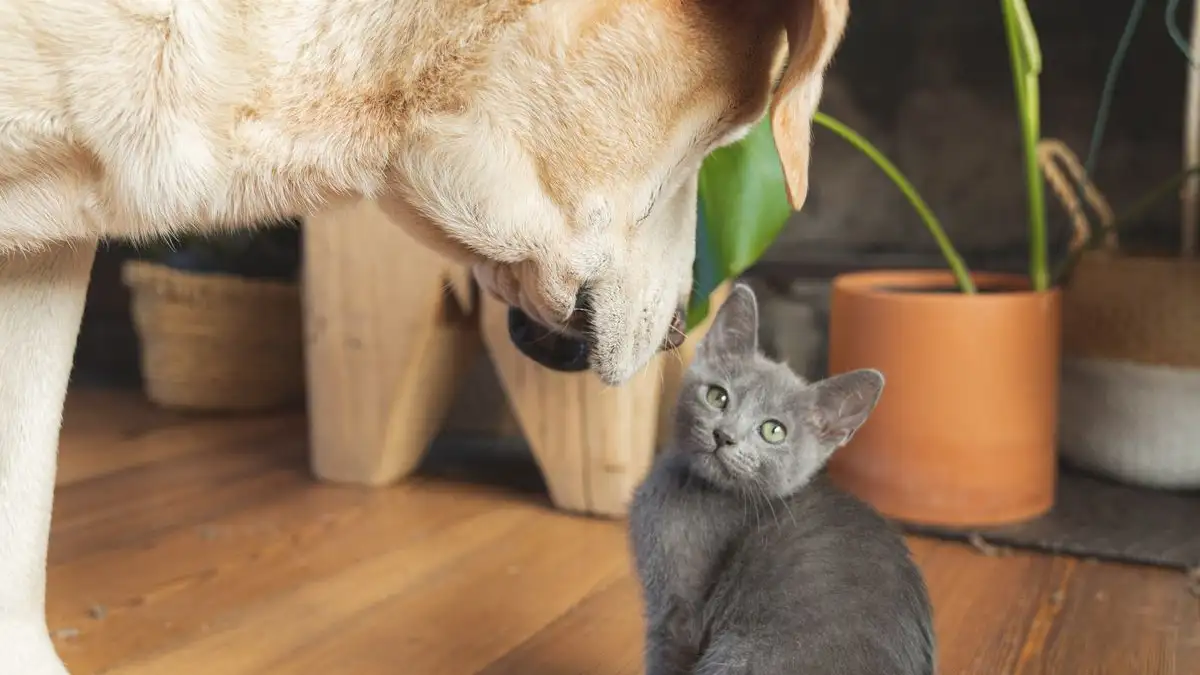
Here's where I was standing when I learned that. Kitchen doorway, hip against the frame, one hand hooked in the dog's collar, watching a cat vanish under a couch in about half a second flat.
The dog was new to the house. The cat had been there eight years and had never lived with a dog in her life. Someone told me to introduce them "slowly," which I translated into waiting a day and then letting them meet in the living room like two people being set up at a dinner party. He lunged. Not to hurt her — he lunged the way he'd have greeted a dog at the park, all front feet and enthusiasm. She went under the couch and stayed there six hours. She didn't eat that night. She didn't use her box until two in the morning, when the house was finally quiet.
That last part is the part I'd want you to notice. Not the lunge. The box.
If you're reading this with a night like that behind you, put down the guilt for a minute. You didn't ruin it. You started at step five and skipped one through four, and one through four are boring as hell and they work.
The steps I skipped, in order
The introduction starts before the two of them are ever in the same room. That's the whole idea, and it's the part that feels like nothing is happening.
For the first several days, the new dog stays behind a closed door or a gate — and not a crate parked in the living room where the cat has to walk past him to get to her own water. Separate spaces. The cat keeps the run of the house, because it's her house and her confidence is the thing that's hardest to rebuild once it's gone.
While that's happening, you swap scent. Take a cloth and rub it along the cat's cheek and chin, where the good smell lives, and tuck it under the dog's bowl. Do the same in reverse with the dog's bedding or a towel he's slept on, and leave it near the cat's resting spot. Nothing gets washed. You want them walking into a room that already smells like the other one and having nothing bad happen.
Feeding on opposite sides of a closed door
This is the quiet engine of the whole thing. Bowl on one side of a shut door, bowl on the other, both animals eating at the same time. Closed door first, not a gate — you want the smell and the sound of another animal chewing, and zero visual. Two minutes, then the bowls come up. If one of them won't eat, you're either too close or too soon, and the answer is more distance, not more repetitions.
What you're building is a very unglamorous association: the other animal's presence predicts food. That's it. I did this for about a week before I touched the gate.
Raising the blanket on the gate
Once both of them are eating normally through the door, you move to a gate. Then you drape a blanket over it so they still can't see each other, and you lift that blanket an inch or two at a time over the next several days. If either animal stops eating, the blanket goes back down. I know how silly that sounds. I also know it took me three tries.
A few physical details that matter more than they seem to. The gate the cat has to deal with should have a gap or a way for her to pass that the dog can't follow. And never leave a leash on a dog who isn't being supervised, even for a minute — a dragging leash is a strangling hazard the second it catches on a table leg.
The first look should last about two minutes
First visual contact happens at a distance, with the dog on a leash and the cat loose and free to leave. Not held. Not carried. Loose. In my house that was the dog at one end of the living room and the cat at the other, call it twelve feet, with the hallway open behind her.
Two to five minutes, a couple of times a day. Then it's over, whether or not anything interesting happened. Ending while both animals are still calm is the rule I'd tattoo on my forearm if I had the space. A session that goes long and ends with one of them bolting teaches exactly the wrong lesson, and it teaches it fast.
The distance you're looking for is the one where the dog notices the cat, then turns his head back to you when you say his name. If he can't do that — if he's locked on, if he won't take a piece of food from your hand — you're too close. Back up. There's no prize for getting them in the same room sooner.
The cat is the one keeping score
Here's the thing I got wrong for longer than I'd like to admit. I was watching the dog. I should have been watching the cat.
A dog who ignores the cat is not the finish line. The finish line is a cat who eats on schedule, uses her box without waiting for the house to go quiet, walks through a room with her tail at normal height instead of slinking along the baseboard, and doesn't flinch when the dog's tags jingle two rooms over. When she stopped waiting until 2 a.m. to use the box, I knew we were getting somewhere, and it had nothing to do with the dog's behavior that week.
Which is why the escape route is not optional and never will be. The cat needs a dog-free zone behind a gate the dog can't get through — litter box, food, and water in there, and yes, all three separated from each other, because plenty of cats won't eat next to where they toilet, dog or no dog.
And the one thing I'd beg you not to do: don't pick the cat up and hold her out for the dog to sniff. That feels like a nice moment. What it actually does is delete her ability to leave, and a cat who has been cornered is where the bites and scratches in this whole process come from. Every time. Let her walk away. Her walking away calmly is worth more than any greeting.
If the meeting already happened and it went badly
This is the part most write-ups skip, and it's the part you actually need if you're reading this at midnight with a cat under a bed.
A chase on day one, or day ten, is a normal setback, not a failed placement. What it means is that the dog got to rehearse the chase, and rehearsed behavior gets stronger. So the job is to stop the rehearsal and start the clock over.
What that looked like for me:
- Forty-eight hours of nothing. Total separation, no visual contact, no shared rooms, no gate sessions. Both animals get their own space and a couple of ordinary, boring days. This is as much for you as for them.
- Back to the closed door. Bowls on both sides, two minutes, twice a day. Several days, maybe a week. If either animal won't eat, you're moving too fast again.
- Scent work again, deliberately. Fresh cloths, fresh bedding, swapped back and forth. This is where I'd give it a full week rather than rushing it the way I did the first time.
- Gate with the blanket down, then lifting an inch a day.
- Distance sessions with the dog leashed, the cat loose, and the sessions ending early every single time.
How long does that take? I can't give you a number, and anyone who does is guessing about your cat. What I can tell you is that the unit of progress is weeks, not days — weeks of short, dull, identical sessions where nothing dramatic happens. If you're doing two or three of these a day and skipping some days entirely because life happens, that's fine. Calm repetitions stack. Dramatic ones don't.
One more thing on this path: if there was a bite or a scratch that broke skin, that's a call to your vet, not a training question, and it isn't something to wait out.
The cue that carries everything else
The single most useful thing I taught that dog was to turn his head away from the cat when I said his name. Nothing fancy. I practiced it in the kitchen with no cat in the room, twenty times a day, marking and paying for the head turn. Then I practiced it with the cat at the far end of the house. Then closer.
"Leave it" works too, and so does scattering a handful of treats on the floor, but the head turn is the one that gives you a dog who notices the cat and chooses you instead. That's the behavior that lets you eventually be in a room together without a leash, and it's the behavior that tells you when you're ready for it.
There's an honesty clause here I'd rather say out loud than have you find out in month three: some dogs have a chase drive that gates manage rather than extinguish. A terrier, a herding dog, a dog with a long history of running cats — for some of these pairs, a household with a gate in the hallway and a cat zone behind it is the good outcome, not a consolation prize. A managed house where nobody is stressed is a success. It just isn't the version in the photos.
What it looks like when it's working
Not nose-to-nose. That's the last thing, not the first, and it's the cat's decision when it happens — usually at a door gap, on her terms, while you stand there trying not to make it into a moment.
What it looks like first is a Tuesday where the dog is on his mat and the cat crosses the room behind him and neither one changes anything. Then a week where she walks past his water bowl instead of around it. Then, months later, maybe, the two of them asleep in the same patch of sun and you standing in the doorway afraid to breathe.
Or not that. Maybe she never gets there. Either way, you'll have two animals who live in the same house without fear, and that was the actual goal the whole time.