The puppy socialization window runs from roughly three weeks of age to somewhere between fourteen and sixteen weeks, and the final dose of the vaccine series usually lands inside that same stretch. The two calendars end within a week or two of each other, which is the entire problem: waiting for the last shot before starting exposures means spending the window waiting, and the window doesn't wait back. The workable answer is to run the two schedules in parallel. Keep the puppy out of dog traffic while immunity is incomplete, and start the exposure work now — carried, held, or set down only on ground that no unknown dog walks on.
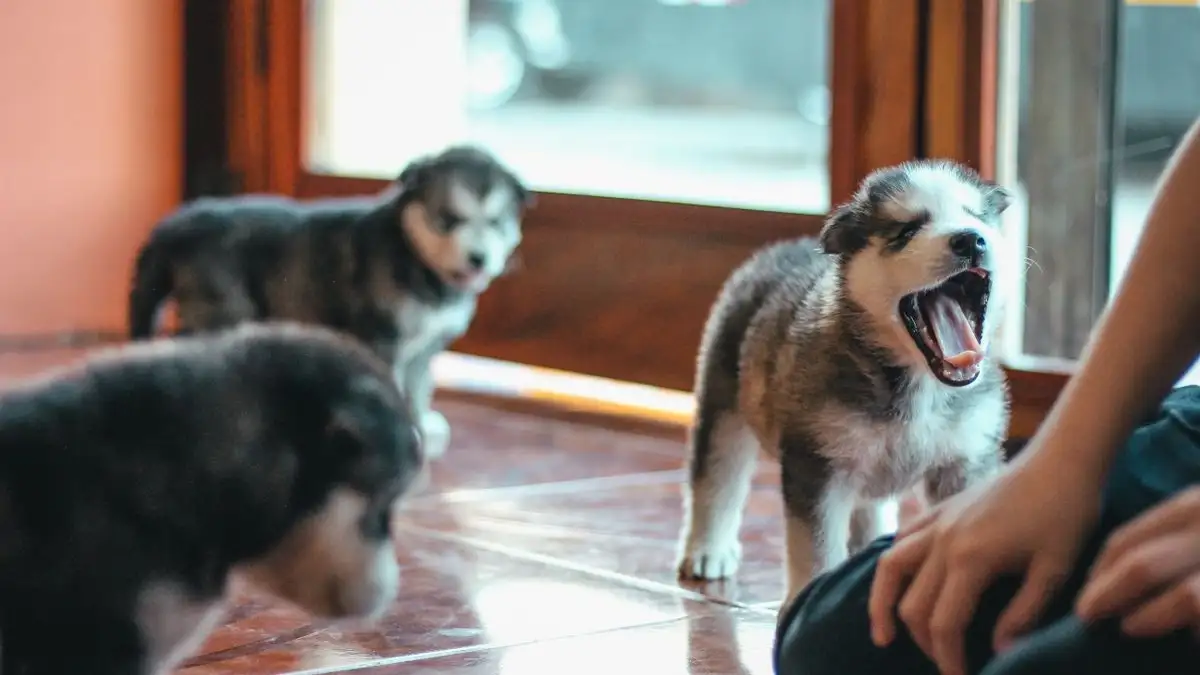
I keep that arithmetic on an index card taped inside a kitchen cabinet, because I get it wrong every time I try to do it in my head. Not the principle. The counting.
Count backwards before you count forward
The thing nobody says clearly enough is that the steepest part of the window is already behind you by the time the shots are finished. Sensitivity to new things is highest somewhere in the six-to-twelve-week range and then declines gradually through about fourteen to sixteen weeks. It's a curve, not a switch. A puppy at ten weeks is cheap to shape. The same puppy at fourteen weeks is more expensive. At twenty weeks it's expensive but not hopeless, and I want to be honest about that, because the hard-deadline version of this story makes people either flood their puppy in week fifteen or give up entirely.
So the first real task is arithmetic. You usually bring a puppy home around eight weeks. Write sixteen on the calendar. Count back. Most people have five to seven usable weeks, minus whatever gets eaten by a spay or neuter appointment, a houseguest, or a week where everyone in the house has a cold. That's the actual runway. Plan against it, not against a vague sense that you have months.
What safe before the shots finish actually looks like
The trade-off my own vet walked me through is real, and it cuts both ways: a carried puppy on a bench has a very small disease risk, and a five-month-old dog who has never heard a garbage truck has a much larger one. The practical rule I use is short enough to remember in a parking lot.
The puppy's feet don't touch ground that unknown dogs use.
That single rule opens more than people expect. A concrete bench outside a hardware store on a Tuesday morning. The tailgate of a truck with a blanket spread on it, parked at the far end of a grocery lot. A folding chair in your own driveway. A friend's fenced backyard, after you've actually asked when their adult dog was last vaccinated. A weekday-morning stretch of paved trail where you can see forty feet in both directions and turn around without crossing anything.
It also closes a specific list, and that list matters more than the open one: pet store aisles, dog park edges, highway rest stops, the clinic lobby floor, and any sidewalk where you can't see what's coming around the corner. High-traffic ground where unknown dogs congregate is where parvovirus lives, and local risk isn't the same everywhere. If your area has a known parvo problem, that's a question for your own vet, not for an article.
Categories, not a hundred-item checklist
There's a genre of socialization checklist with a hundred boxes on it, and I've never met anyone who finished one. Categories are what matter. There are six.
Surfaces: grass, wet grass, concrete, asphalt, gravel, a metal drainage grate, wood decking, tile, something that shifts underfoot, a plastic tarp.
Sounds: the vacuum in the next room, the dishwasher, the garage door, the doorbell, the blender, a dropped pan, footsteps overhead, a lawnmower two yards away.
People: different heights, ages, voices, and gaits. Hats, beards, sunglasses, umbrellas, canes, wheelchairs, strollers, delivery uniforms, someone carrying a large box.
Handling: paws, ears, mouth, tail, collar, being picked up, being handed to another person, a towel rub, a hand reaching over the top of the head.
Calm vaccinated adult dogs: a dog whose vaccine status you actually know, and whose temperament is calm and appropriate. A bouncy, rude adolescent is often worse than no dog at all, and temperament matters more than breed here.
The ordinary objects of your own house: a broom, a suitcase, a cardboard box, a paper bag, an umbrella snapping open.
That's roughly thirty items, and thirty is doable in five weeks if you don't waste days.
Order is the part people skip
This is where the schedule actually gets made, and where I see the most avoidable damage. Sequencing beats volume every time.
One new variable at a time. If the surface is new, keep the location boring. If the location is new, keep the surface familiar.
Start at the weakest version of the thing. The vacuum runs behind a closed door in another room before the vacuum is visible, and it's visible while switched off before it's moving. Find the quiet end of the spectrum and begin there.
Distance is a dial. A stroller forty feet away is a different exercise than a stroller six feet away, and the forty-foot version is the one you should be doing this week.
Repetition beats intensity. Three four-minute outings on three separate days will do more than one twenty-minute session.
Don't stack. Two new things in one afternoon and you can't tell which one caused the reaction, and if it goes badly you've soured both of them at once.
Log it. Date, what, distance, how long, and what the puppy did. Two lines in a notes app. The log is the only thing that tells you when a category is genuinely covered and when you're just repeating the same easy item because it feels good.
End while it's still going well. The last thirty seconds should be the easiest thirty seconds, not the hardest.
Finding ground where unknown dogs can't reach you
Timing does more work here than location. Dog walking has two peaks: early morning and right after work. The same sidewalk at ten in the morning on a Tuesday is a completely different place than it is at 6:15 on a Wednesday. Rain helps. Cold helps. So does the far corner of a parking lot, and a trailhead that isn't the popular one.
Pick spots with sightlines and an exit. You want to know what's coming before it arrives, and you want to be able to walk away without crossing anything.
If a loose dog heads toward you, pick the puppy up. This is the one moment when carrying is the correct call, and it's the reason a sling or a set of arms belongs in the setup rather than in the afterthought column.
The most controlled environment you have is your own home. Use it for the hardest categories, and save the outings for the ones your house can't provide.
Reading a puppy who is asking for distance
An exposure only counts if the puppy stays in a state where he can still take information in. That sounds abstract until you know what to look for, and then it's obvious.
Watch for the head turning away, lip-licking when there's no food around, yawning when he isn't tired, sudden intense sniffing of the ground, sitting down and refusing to move, a tucked tail, ears pinned back, the whites of the eyes showing, trembling, a sudden shake-off, or scratching at nothing. Watch for a puppy trying to climb behind your legs or pull back toward the car. And watch the food. A puppy who was taking treats and stops taking treats has told you everything you need to know.
Any of those means the distance grows or the session ends. Not one more repetition to see whether he settles. That's the mistake I've made, and what it teaches is the exact opposite of what you want: that the world is a thing to be endured until it stops.
A puppy who takes a treat, looks at the thing, and turns back to you is usually still fine. That's the gauge I lean on more than any other — the treat test. Food keeps working right up to the edge of the threshold and stops right past it.
What gets cut when the calendar is short
You will not cover everything, and pretending otherwise just adds guilt to an already tight five weeks. So rank instead.
First by frequency. What will this dog actually encounter every week of his life? A city apartment dog needs elevators, grates, scooters, strollers, bikes, crowds, stairs, sirens. A dog on ten rural acres needs gravel, equipment noise, a kennel run, and the sound of a truck in the driveway. A dog in a house with a toddler needs small fast humans above almost everything else.
Then by cost if it stays hard. A dog who never meets a horse is fine. A dog who panics at children is a daily problem for the next decade.
Some of the window will get lost. A puppy picks up a stomach bug, someone in the house gets sick, the weather turns for a week. That's normal and survivable, because the edge of the window is soft. Learning doesn't stop at sixteen weeks. What changes is the price of each lesson. The window isn't a deadline to beat. It's a runway, and the only real failure is leaving it unused.