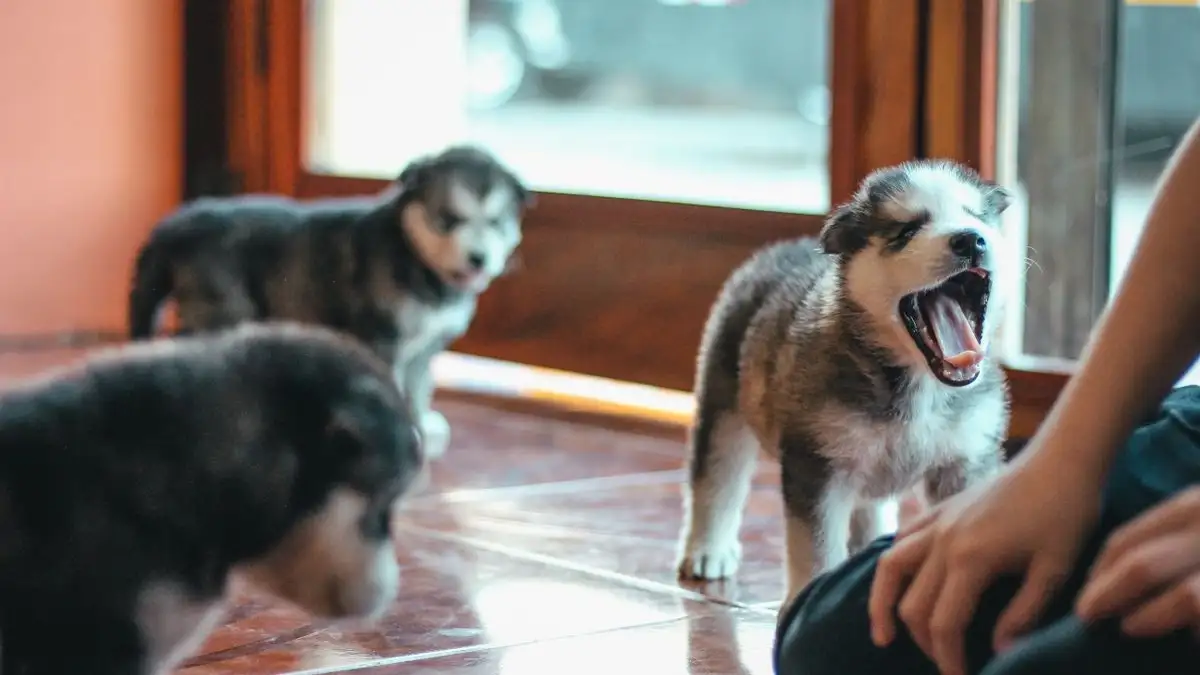
Puppy milestones are windows rather than due dates, and each one is the visible edge of a body system or a skill coming online: eyes, ears, bladder control, bite inhibition, balance, the social brake that stops a mouth mid-bite. Healthy puppies land inside any single window across a two- to three-week spread, with small breeds at the early edge and giant breeds trailing at the late edge. The useful question is never whether the puppy is on schedule this week; it is which system is arriving, and whether the range is still open.

I keep a spiral notebook on the kitchen counter, and it exists because of an answer I gave badly.
The puppy was on the stainless steel scale at the vet's, sliding a little, and I had a hand under her chest to keep her steady. The technician asked the standard question — anything you've noticed since last time? — and I said no, she's great, and meant it. Then I drove home and, somewhere around the second traffic light, remembered four things. She had turned her head toward the refrigerator door closing, twice, which meant sound was landing. She had stopped flinching when the mail slot snapped. She had stood at the bottom of the two porch steps and looked up instead of barreling. Four observations, all of them worth saying out loud, all of them gone from my mouth at the moment it mattered. Not because I hadn't seen them. Because I hadn't written them down, and a memory without a date is not a record.
That is the failure mode with milestones, and it isn't the one people worry about. Nobody misses their puppy walking. What gets missed is the ordinary stuff that would have answered the vet's question: when did this start, is it new, is it gone.
The first three weeks run on a schedule you can't influence
Puppies are born with their eyes sealed and their ear canals closed. There is nothing to train in that period, nothing to expose, nothing to socialize — the body is still completing basic wiring. The eyes typically open somewhere around ten days to two weeks, and the ears begin to work a week or so after that. What arrives first is smell and touch and warmth-seeking, which is why a newborn puppy in a pile moves toward the pile and not toward you.
Standing and stumbling forward comes around three weeks. By four weeks they're walking with something you'd recognize as intent, and by five they're wrestling. If you're watching a litter, that's the sequence. If you have a puppy that came home at eight weeks, all of it is behind you and none of it is your responsibility to re-create.
Three to twelve weeks: the window that closes
This is the part of the first year I'd circle if I could only circle one thing, and it isn't really about obedience.
Bite inhibition gets installed first, and it gets installed by littermates. When a puppy bites a sibling too hard, the game stops — the other puppy yelps and disengages. That feedback, repeated a few hundred times between roughly three and eight weeks, is what teaches a mouth to modulate pressure before it ever meets a human hand. It's one reason a puppy that stays with the litter until about eight weeks tends to arrive with some of that already built in, and a puppy separated earlier has to learn it somewhere else.
The broader socialization window runs somewhere in the range of three to about twelve to sixteen weeks. I use a range there deliberately, because the exact closing point is argued about and the practical advice doesn't change: what a puppy meets calmly in that stretch, it tends to file under normal; what it misses in that stretch may need slow, patient work later. You're not trying to show the puppy everything. You're trying to show it enough that the world reads as boring.
Around eight to eleven weeks there's a stretch where new things land harder than they should. A puppy that was fine with the vacuum on Monday may be alarmed by it on Thursday. That isn't a regression and it isn't something to push through. Keep the week quiet, keep the exposures easy, and let it pass.
Teeth, bladder, and the things you can measure
Physical milestones are the easy ones because they leave evidence.
Baby teeth start erupting around three to four weeks, and a full set is usually in by six to eight weeks. The adult teeth begin replacing them around four months and finish somewhere near six or seven. You'll find teeth on the floor, and the chewing impulse climbs right along with it — that's a mouth changing shape, not a behavior problem.
Bladder control is a nervous-system milestone wearing a house-training costume. Newborn puppies have essentially none. By eight weeks most can hold for something like two hours, and the capacity stretches gradually from there — longer stretches by day before the same stretch holds overnight. The muscles and the signaling are still maturing through the first several months.
Coordination has its own slow curve. Stairs, jumping down from furniture, tight turns at speed — the ability arrives in that order, and the confidence arrives ahead of the ability, which is why so many early stumbles happen when a puppy is sure and the body isn't.
Why the calendar lies, and size is the reason
Two puppies born the same week are not on the same clock.
Small breeds tend to hit developmental markers earlier across the board — growth plates closing somewhere in the six-to-eight-month range, physical maturity arriving before the first birthday. Large breeds push all of that later, and giant breeds later still, with growth plates sometimes not finished until well into the second year. So an eight-month-old giant-breed puppy can look like a finished adult animal and still be, developmentally, a puppy: softer joints, an unfinished skeleton, a brain that hasn't caught up to the body it's driving. And an eight-month-old toy breed is close to done.
This is the single most useful thing I know about milestone charts. A chart with fixed dates is written for an average puppy that doesn't exist. A chart with ranges, adjusted for adult size, is something you can actually use.
What goes in the notebook, and what doesn't
The log is three lines a week, written on the same evening, and the weekly part matters more than the three lines.
Date. One physical thing I saw. One behavioral thing I saw. If there's something I'm unsure about, that goes in the margin.
Physical things are countable: weight on the same scale at the same time of day, which teeth are present, whether she took the stairs down instead of up, how far she jumped. I'm tracking the trend, not the number. A puppy whose weight curve is climbing steadily is telling me something different from one whose curve has flattened, and that's a conversation for the vet, not a conclusion for me.
Behavioral things get a first-seen date and nothing else: first time she tracked a sound across the room, first voluntary approach to something new instead of a retreat, first night with no interruption, first time she checked in with me instead of the other way around.
What does not go in the notebook: anything I'd be embarrassed to write down, and anything I'd need to check daily. Daily tracking is how a reference tool turns into a low-grade anxiety habit. Once a week is enough to build a record, and it's sparse enough that I'm not reading it like a scoreboard.
Using the record at the well-puppy visit
The notebook goes with us. When the question comes — anything you've noticed? — I read the last three entries instead of improvising.
Two things turn out to be genuinely useful to the vet. One is the weight trend over weeks, which is more informative than a single number on the day. The other is a specific absence: a window that closed with nothing in it. Not a late milestone. An empty one. If I never saw a startle response where I'd have expected one, or a puppy that isn't walking by the far edge of the normal range, that's not something I try to interpret at home. It's a sentence I say out loud in the exam room, with the date attached.
When a milestone slips
Most slips are just the spread doing its job. A puppy two weeks behind on some skill is still inside the range for a lot of things, particularly if it's a large breed. Late is not the same as absent, and absent is not the same as abnormal — but absent is the one worth a phone call rather than another month of waiting.
The honest limitation here is that I can describe what I've seen and what I haven't. I can't tell you what it means. What the record does is make the question sharper when you hand it to someone who can.
The larger point, the one I'd want someone to take from all of this: the first year is a sequence, and sequences have an order. Sensation, then movement, then the social brakes, then the teeth, then the long slow finish that depends on how big the dog is going to be. You are not completing a checklist. You're watching a body and a nervous system assemble, mostly on a schedule that was set before you met, and your job is to notice what's arrived and to say something when a whole window goes by empty.