Puppy food stops being right when the dog stops growing, and the two things that tell you that has happened are the AAFCO statement printed on the bag and the body condition of the dog standing in front of you. Small breeds usually cross that line somewhere between nine and twelve months. Large and giant breeds stay on growth food well past a year, often well past eighteen months. The change itself is a blend stretched across days, and the mistake that shows up most often is not the formula at all. It is the portion that never got adjusted.
I have stood in the pet store aisle with a bag tipped under the fluorescent light and my phone flashlight on, squinting at the nutritional adequacy statement in six-point type next to the guaranteed analysis, and I have done it more than once, because the answer is not on the front of the bag. The front of the bag is marketing. The statement is the fact.
The one sentence that tells you what the food is for
Read it exactly. It will say the food is formulated to meet the AAFCO Dog Food Nutrient Profiles for one of three things: growth, adult maintenance, or all life stages. Growth means puppies. All life stages means it clears the bar for puppies and for pregnant or nursing dams, which makes it a growth food with a broader label on it. Maintenance means a dog that has finished growing.
That single line answers who the food was built for. What it cannot tell you is whether your particular dog is done.
If the bag says growth and your fourteen-month-old Chihuahua mix is still eating it, you have been feeding puppy food to an adult for a couple of months. That is not a crisis. It is also not nothing.
Growth is a process you can see, not a date on a calendar
I do not trust the calendar much here, and the breed ranges are ranges for a reason. Nine to twelve months covers the small breeds. Large and giant breeds are the ones that surprise people, because a Great Dane who is still filling out at twenty months is not behind schedule, and littermates can finish at noticeably different times from each other. A chart that says twelve months is describing a population, not your dog.
What I trust instead is my hands and my eyes, in that order.
Run your palms flat down the sides of the rib cage. You should feel ribs easily under a thin layer of covering, closer to the feel of the back of your hand than the palm. If you are curling your fingertips to find them, the layer is thicker than it should be. Then stand over the dog and look straight down. There should be a visible indentation behind the rib cage where the waist is. From the side, the belly should tuck up from the rib cage toward the hind legs rather than hanging level. If the waist has gone straight and you are pressing to feel ribs, that is no longer a growth question. That is a portion question, and it will not fix itself.
There is a third signal, and it shows up in the bowl before it shows up anywhere else. Puppy food is calorie dense and it smells like it. When a dog starts leaving kibble sitting at meals that used to disappear, that is often the first hint that demand has dropped.
The switch is a blend, and the portion is the part people miss
Treat a life-stage change exactly like any other food change. Mostly old food at the start, a small amount of the new, shift the ratio every couple of days, watch the stool. Most dogs get through it in about a week. A sensitive stomach takes longer and does better with smaller steps. Nothing about it being a life-stage change makes the process different. The gut does not care why the formula changed.
The portion is where it goes sideways. Adult maintenance food is generally less calorie dense per cup than growth food, and the dog's calorie needs fall once growth stops, so both the food and the dog step down at the same time. If you keep scooping the same cup you have been scooping for a year, the math quietly works against you. Ten percent too much is invisible in a week. Over a few months it is a pound or two, and because you look at the dog every single day, you will not see it happen. You will see it in a photograph from last spring.
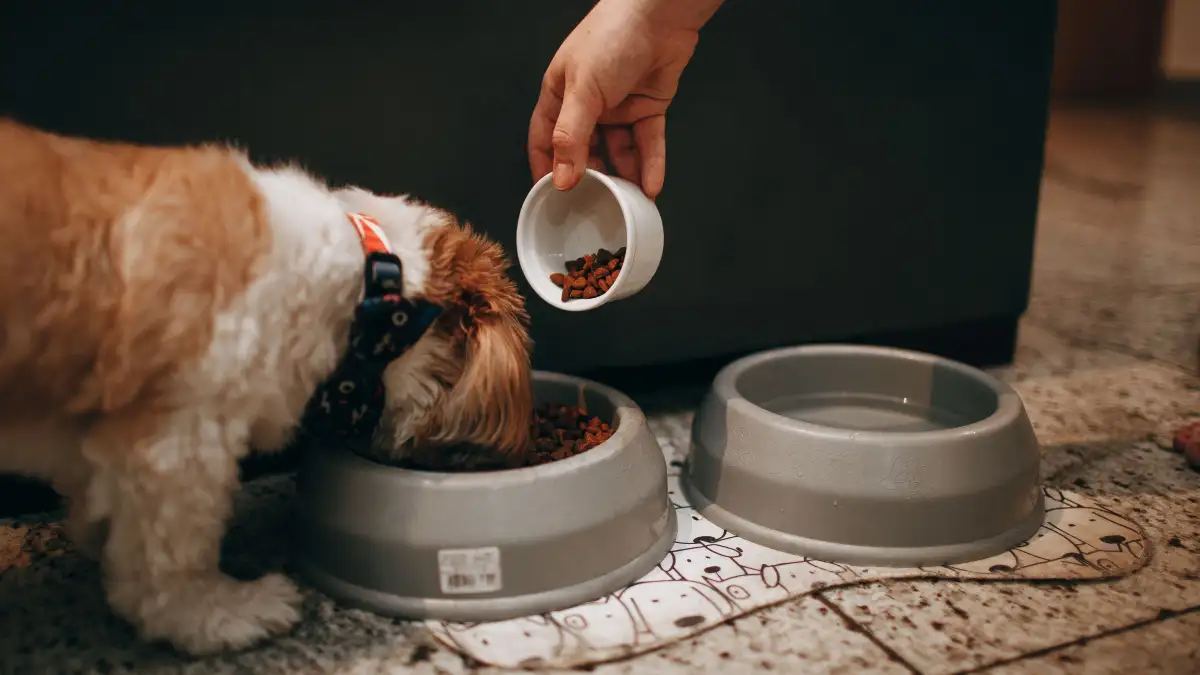
After any change, I weigh the cup for a week. A cheap kitchen scale, a level cup, done. It is the only way I know to catch a portion drift before it turns into a body condition problem I have to fix later.
The exam at that age is the checkpoint
This is the part most people skip, and it is the part I would keep if I could only keep one thing. Somewhere around the age your dog finishes growing, there is a routine exam worth doing on purpose instead of as a formality. The vet puts the dog on the scale, runs their hands over the ribs and along the spine, and gives you a body condition score. That last number is worth more than any chart on the internet, because it is attached to your dog.
That visit is also the moment when someone else's hands are on the animal. You are not going to feel half a pound on a Labrador you pet every morning. They will, in about four seconds.
One thing worth saying plainly: for large and giant breed puppies, the mineral balance in a growth food is not trivia, and it is one of the few places where the label genuinely matters rather than being marketing. That is also squarely a conversation for your vet, not for me and not for a forum thread.
The other end of the same question
Senior food runs on the same logic, just years later.
Senior diets differ wildly from one another. Some drop calories. Some shift the protein level up or down. Some carry added ingredients aimed at joints. Some are close to adult maintenance in a different bag with a dignified name on it. Because there is no single senior formula, there is no single age at which senior food becomes correct.
What actually decides it is body condition and activity. A seven-year-old who holds weight easily, moves without hesitation, and cleans the bowl does not have a problem a senior bag solves. A ten-year-old who is losing muscle along the spine, slowing on the stairs, or drifting down in weight might have a real reason to change diets, but which diet is a conversation with a vet rather than something to grab off a shelf. And the reverse case matters too: if a dog is gaining on adult maintenance food, the first answer is usually a smaller measured portion, not a new bag.
What I actually do, in order
Read the statement on the bag and write down which of the three categories it falls into. Put my hands on the dog and check ribs and waist honestly. Blend the new food in over about a week while weighing the cup. Book the exam around the age growth ends, and let the body condition score at that visit be the thing that decides the portion, and later, the diet.
If your dog is managing a diagnosed condition, or is already on a diet a veterinarian chose, none of this overrides that. This is the ordinary path for an ordinary dog. It just happens to be a path with a stopwatch, and the stopwatch is your hands, not the calendar.