Two dogs on two different foods need three things locked in place before the first scoop leaves the bag: a feeding spot for each dog that the other one cannot walk into, meals that go down and come back up on a clock instead of sitting out all day, and a rule that only one dog changes food at a time. The bowl itself, the room, the order you set things down in, all of that is adjustable. Those three are not. Skip them and you lose the only thing a diet change is supposed to give you, which is the ability to say with some confidence that the loose stool on Tuesday came from the new bag and not from the other dog's leftovers.
I want you standing in my kitchen at 6:40 on a weekday morning, because that's where this actually gets decided. Not at the pet store, not in the vet's exam room. Right there on the tile, half awake, with two dogs orbiting your ankles.
There's a bag on the counter with a strip of masking tape down the side. On the tape, in marker: a name, a date, and a portion. There's a second bag in the pantry with no tape on it at all, and that absence is doing work too, because it tells me at a glance which bag belongs to which dog without me having to read anything.
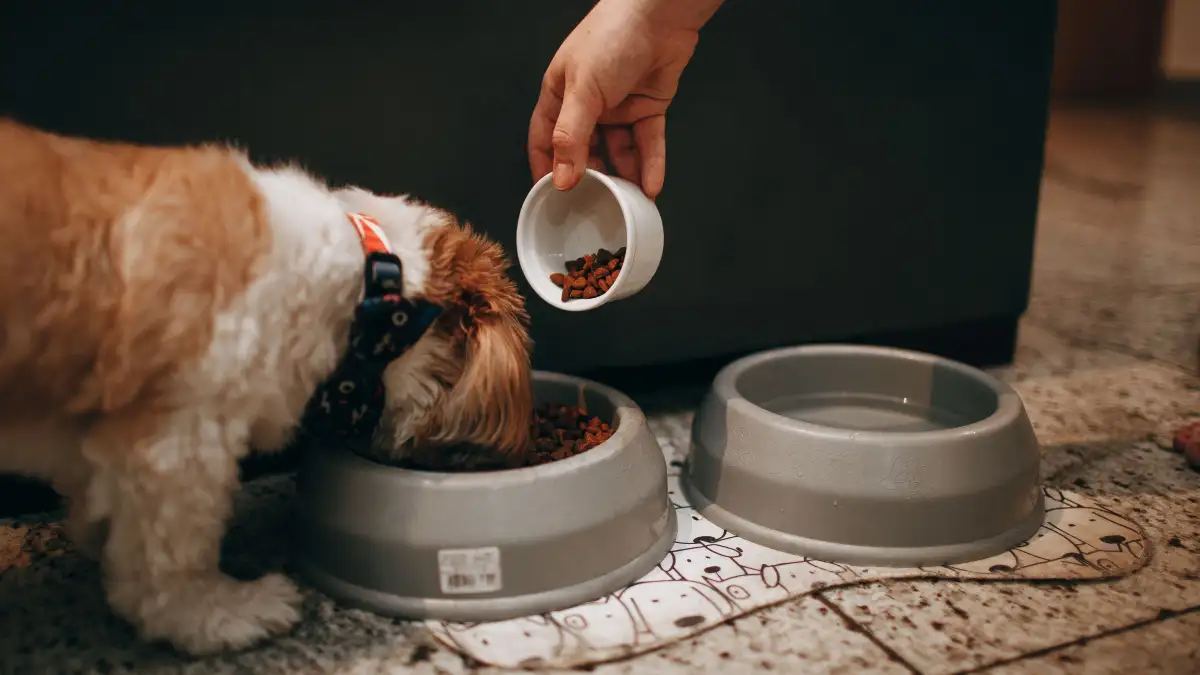
Two bowls on the floor, six feet apart. In my kitchen that means one sits by the dishwasher and the other sits by the back door. The older dog eats slowly. He walks away from his bowl twice before he finishes, stands in the middle of the room, thinks about something, comes back. The puppy finishes in about ninety seconds and then stares at the other bowl like it's a problem he fully intends to solve.
If those two bowls were in the same corner, or if I left them down after breakfast, the whole system would fall apart by Thursday.
The real goal isn't the right food in the right dog
It's keeping the two foods from ever touching. That's the actual objective, and I didn't understand it for a long time. I thought success meant the older dog got his bag and the puppy got his, and as long as I was reasonably careful we were fine.
We weren't fine. We were blind.
Here is what happens when the foods mix. Both dogs eat a little of the wrong thing. Maybe not much. Maybe a few kibbles the puppy hoovers up while the older dog is off in the middle of the room having his little moment. Then a week later one of them has softer stool, or gets itchy, or turns his nose up at dinner. Now you have two suspects and no way to separate them. You change something, wait, change it back, wait, and burn two or three weeks you could have spent actually fixing the problem.
The mix-up doesn't have to be dramatic to ruin the read. A shared bowl doesn't have to be a shared bowl. It just has to be a bowl that one dog can reach.
What "separate" actually looks like on a normal day
A real barrier, not a symbolic one. A closed interior door is the gold standard because it's free and it's already installed. A gate in a hallway works. So does a bathroom, a laundry room, a crate with the door shut, or the far side of a kitchen island if your dogs are small and lazy and you're honest with yourself about which of those two things they are.
We have run it both ways. For a stretch the older dog ate in the bathroom with the door closed, which he hated for about four days and then accepted completely. The puppy ate in the kitchen and howled at the door like the world was ending. That howling is the tax. You pay it for a week.
What matters is that neither dog can cross the line while food is on the floor. Standing in the middle of the room and playing referee with your body is a plan that works exactly until the morning you're running late.
The ten-minute clock
Meals go down, stay down for ten to fifteen minutes, and get picked up. Both bowls. Even the one with food left in it.
This is the piece people skip, and it's the piece that makes the rest possible. Free-feeding is what lets dogs graze, and a grazing dog will eventually find the other bowl. It's not a discipline failure. It's just arithmetic: a bowl that's available for eight hours gets investigated.
There's a useful side effect. Once meals are on a clock, appetite becomes readable. A dog who usually cleans the bowl and then leaves half of it is telling you something, and you'll only catch it if you're the one picking the bowl up.
If both your dogs are free-fed right now, that's a change in itself. Make that change first, hold it steady for several days, and only then start swapping food. One variable at a time, always.
Switch one dog
Only one dog is in transition at any given moment. If both dogs are moving to new food and both get gassy, you've learned nothing, and you'll spend the next month guessing.
Which dog goes first depends on why you're switching. If one dog is switching for a medical reason, that dog goes first and the other one waits. If one dog is a raider, the raider's routine gets locked down first, because until his feeding behavior is predictable, nothing else is reliable. Either way, the second dog starts only after the first dog has been stable on the new food for a while.
Keep the notes. Date, food, portion, and anything you noticed. It feels excessive for about three days and then it saves you a vet call.
Bowls don't share storage
Pick both bowls up, wash both, store them apart. Don't stack them. Don't let them share a shelf where one sits inside the other.
A bowl with a smear of the new food in it that the other dog licks clean is a small dose. But a small dose every single day is a variable you didn't choose, and it's exactly the kind of thing that muddies a two-week transition. Wash with hot water, dry them, put them where they live. If the bowls look identical, tape the rim of one. Not for the dog. For you, at 6:40 in the morning, when you are not at your sharpest.
Water is a different story. A shared water bowl is fine, and trying to keep two water bowls separate through a whole day is a losing battle. The thing worth watching is the drinking itself. Who is at the bowl more than usual. Who is passing it by. Thirst changes are often an early signal of something, and they're worth a vet call rather than a guess. Just don't read a change in drinking as proof of anything on its own.
When someone gets the wrong bowl
It happens. A guest feeds them, a kid helps, you're late and you grab the wrong scoop. Don't spiral.
Write down the date and what got swapped, then hold both diets exactly where they were for several days and let things settle. What you can't do is keep adjusting in response to every small change, because that's how you end up with no baseline at all. A single swap usually costs you a few days of clean data, not the whole transition.
The parts this doesn't solve
This is logistics. It is not behavior work. If one dog guards the bowl, freezes over it, or goes stiff when the other dog walks past, routine separation at mealtimes is not the fix for that, and this article isn't pretending to be. That's a separate problem with a separate approach.
And not every house can do a closed door. Small apartments, crates in one room, a dog who screams behind a barrier for twenty minutes. In those cases you lean harder on timing instead of space: feed the fast eater first while the slow eater waits in another room, then swap, and put your body in the middle while it's happening. It's more work and it's less clean, and it's still better than two bowls in one corner.
The system exists for one reason. So that when something goes wrong, and something will, you know which bag to look at. Two dogs, two bowls, two spots, one change at a time. Everything else is decoration.