Veterinarians set a weight-loss calorie target from the dog's ideal weight, not its current weight: they figure out what that ideal weight would need for maintenance, take roughly 80 percent of it as a starting point, and then adjust the number every few weeks based on what the scale actually does. The chart printed on the bag is a maintenance estimate for a different dog.
You are in the exam room with me when it happens. The dog is doing his nervous four-step shuffle on the stainless table, toenails ticking against the metal, and the vet is over at the little counter by the sink, typing. She says the numbers out loud the way you would read a label. Ideal weight, thirty pounds. Current weight, thirty-eight and a half. Then she opens a calculator on the desktop, taps for about nine seconds, and writes a single number on a sticky note. That number is the day's food. Not the range printed on the bag.
I have sat through that scene with two different dogs now, and what I keep noticing is how unremarkable it looks from the vet's side. She is not consulting a chart. She is doing arithmetic, and she is doing it from the weight the dog should be, not the weight he is.
The target weight comes first, and everything downstream depends on it
When you feed a dog at the maintenance level for his current weight, you are feeding the fat. That is the whole problem in one sentence. Body fat is metabolically quiet compared to lean tissue, so if you calculate calories for thirty-eight pounds and pour them into a dog who ought to weigh thirty, you have built a plan whose only possible outcome is holding steady.
So the first thing that happens is the vet decides what the dog should weigh. For some dogs that is obvious. For others it is a judgment call made with hands on the ribs and a look at the breed standard and a memory of what this dog weighed at his last good checkup. It is not always perfect, and a good vet will say so.
Get that number wrong in either direction and the rest of the math is off. That is why the target weight is the part worth writing down and asking about, even more than the final calorie figure.
Where the 80 percent comes from
Once the vet has an ideal weight, she converts it to kilograms, because the standard resting energy formula works in kilos. The formula takes the ideal weight in kilograms to the three-quarter power and multiplies by 70. The result is roughly what that body needs at complete rest.
Then she multiplies by a life-stage factor. A neutered adult dog usually lands around 1.6. An intact or genuinely hard-working dog sits higher. Some seniors sit a little lower. That product is maintenance calories for the ideal weight.
Then she takes about 80 percent of it. That is the usual veterinary starting point for weight loss. Not 50, not 60. Cutting too hard is its own problem, and it also tends to produce a dog who is frantic about food, which makes the whole project harder to sustain.
Here is the arithmetic on that exam-room example. A thirty-pound ideal weight is about 13.6 kilograms. Run the formula and you get close to 500 calories at rest. Multiply by 1.6 and you are near 800 for maintenance. Take 80 percent and you land in the mid-600s. That is the sticky note.
Change the dog and every one of those numbers changes. That is the point of showing it. The mid-600s is not a recommendation for your dog. It is what the method looks like when you watch it happen.
What the label actually gives you, and what it does not
The calorie statement on a bag or can says kcal ME per cup, per can, or per kilogram. What it does not say is how much a cup of that particular food weighs, and that is where people lose the thread.
Cup volume is the same. Cup weight is not. Two foods can both call it a cup and differ by a wide margin in grams, because kibble density varies enormously between shapes and formulations. If you scoop by volume, your "cup" can drift by a meaningful percentage of the day's calories without you ever noticing.
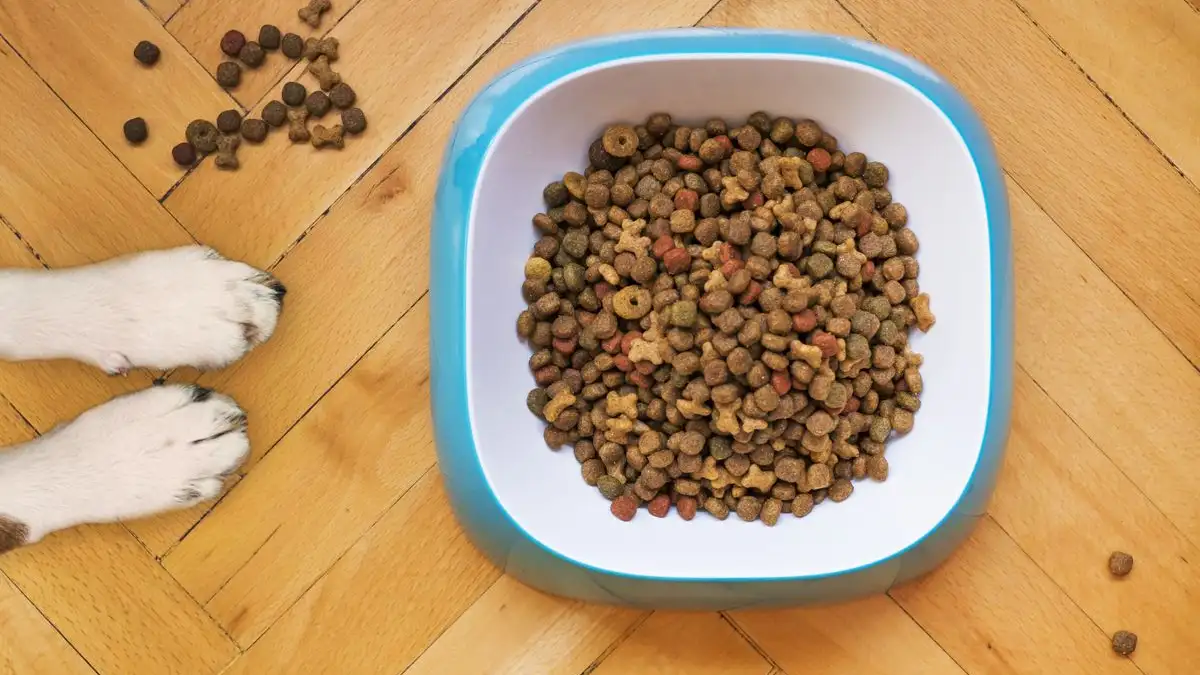
A kitchen scale settles it. Put the bowl on the scale, tare it to zero, and add kibble until the display reads the gram target. Divide the day's calorie number by the food's kcal per kilogram, then multiply to get grams. Weigh out a few days in advance if mornings are chaotic, and keep the portions in labeled containers.
I keep the scale on the counter, not in a drawer. Anything in a drawer does not get used at six in the morning.
Treats come out of the same bucket
Nobody likes this part. The dental chew, the training treats in my jacket pocket, the crust of toast, the last bite of whatever the dog is staring at during dinner. All of it counts, and it all has to come off the top of the daily food portion rather than sitting on top of it.
A workable habit is to set aside a small allowance for the day and pull the same number of grams out of the bowl to pay for it. Some vets suggest keeping treats inside a modest slice of the daily total. Whatever the exact split, the principle is the same: there is one number per day, and everything the dog swallows comes out of it.
The number the vet gives you is a guess. The dog is the one who confirms it.
This is the piece that bags never explain. The starting figure is an estimate built from a formula and a target weight, and formulas are not dogs.
So you weigh the dog. Same scale, same day of the week, same time of day, ideally before the first meal. For a large dog who will not sit still on a kitchen scale, weigh yourself holding the dog and subtract your own weight. Write the number down somewhere you will actually look at it. If you only keep it in your head, you will remember the direction and forget the amount, and the direction is the part that lies to you.
A typical safe rate of loss is around 1 to 2 percent of body weight per week. On a thirty-eight pound dog, that is somewhere between six and twelve ounces. Less than a pound. Which is exactly why so many people give up on a plan that is working fine. They are watching the dog's outline, which changes slowly, instead of the scale, which changes a fraction at a time.
What to do at the three or four week mark
If the dog has lost at the expected rate, the number is right and you keep going.
If the dog has lost nothing, the first thing to check is the measurement, not the dog. Are the grams actually being weighed, or is it back to the scoop? Is someone in the house quietly slipping extra food? Are the chews being counted? Then bring the food log and the weight log back to the vet and have the estimate reviewed. Do not simply cut the portion in half on your own.
If the dog is losing faster than 2 percent a week, that also goes back to the vet. Faster is not better here.
Free-feeding ends the measurement, and the measurement is the whole plan
You cannot adjust a number you never measured. A bowl that gets topped up whenever it looks low gives you no idea what the dog ate yesterday, which means there is nothing to compare against the scale, which means the vet is working blind at the next visit.
Meals at set times with a measured amount is not about strictness. It is about having a signal. You want to be able to say: this many grams, every day for three weeks, and here is what the scale did.
A few honest limits on all of this. The method works for a healthy dog who needs to lose fat. It is not a treatment for a medical condition, and a dog who is losing weight without being fed less, or who has other symptoms, needs a vet rather than a smaller scoop. The target weight itself is an estimate that sometimes gets revised. And the formula is a starting point for a conversation with someone who has actually put hands on your dog, not a substitute for that appointment.
