An energetic dog can be tired out in an apartment with no yard, but not by trying to rebuild the yard indoors. What actually drains a high-energy dog is nose work, problem-solving, and short structured sessions spread across the day, with the running placed wherever the neighborhood legally allows it. Most people fail at this by chasing cardio alone: the dog gets fitter, the apartment gets smaller, and the evenings get worse. Put sniffing first, thinking second, movement third, and rest on purpose, then write a weather-proof version of the same day while the weather is still good.
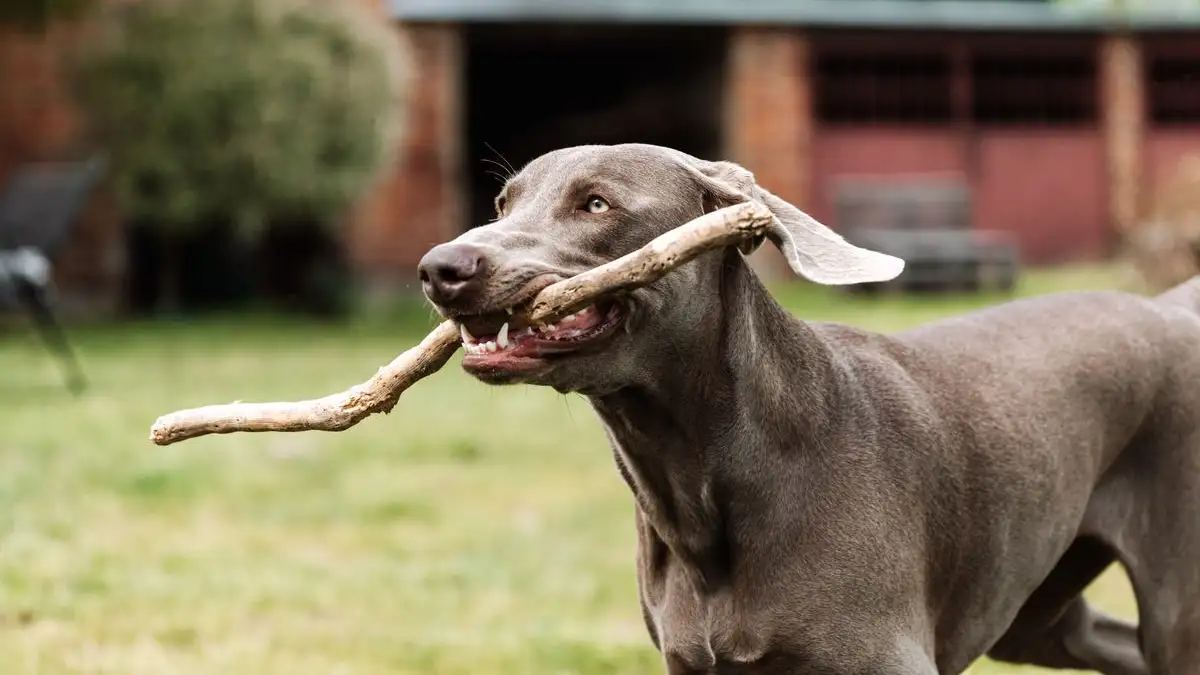
I live on the second floor of a building with one long hallway, one shared stairwell, and no fenced space of my own. The dog I share it with is young, quick, and built to move. For the first year I measured his exercise in miles, and I was wrong about nearly all of it.
The walk that does the work is the slow one
I used to treat the morning walk like a delivery route: out the door, cover ground, get home. Two miles at a decent clip, and by the time I unlocked the door I felt like I had done right by him. Then I would sit down at my desk and listen to his nails on the laminate, click, click, click, back and forth down the hallway, and by mid-afternoon he would be standing over me with a toy in his mouth, breathing at me.
The fix felt lazy enough that I resisted it for weeks. I let him stop.
Four minutes on the same three feet of sidewalk, where the neighbor's dog had marked and someone had dropped half a bagel and the trash truck had idled that morning. Nose to the concrete, tail low and loose, breathing out through his nose in long slow pulls. Then he lifted his head, looked at me, and we walked on. Six stops like that on a loop I used to power through in eleven minutes.
That walk tires him in a way the fast one never did. Not because sniffing is cardio, because it isn't. It's closer to reading a dense page while walking. His nose is running an analysis the whole time: who was here, how long ago, what they ate, whether they were well. That is cognitive load, and cognitive load is what puts a dog flat on the rug at noon instead of pacing the hallway.
Why a city walk is not the same as a run
Here is the part that took me longest to understand. In a dense neighborhood, a walk is never only a walk. There are scooters, other dogs, delivery drivers, a stroller coming around a corner. All of that is work for an excitable dog, work that leaves him aroused rather than settled.
The tell is what happens in the first five minutes after you get home. A tired dog drinks, circles twice, and lies down. A wired dog follows you into the kitchen, drops a ball at your feet, and does not stop moving.
If the second version is your dog, the answer is not more distance. It's fewer triggers and more time. I pick routes with fewer intersections, walk when the block is quiet, and cross the street rather than practice a sit-stay next to a barking dog behind a fence. Same walk, less input, more settling.
The gap sniffing cannot fill
I want to be honest about this, because the internet version of this advice usually skips it. Sniffing walks do not replace running. If your dog is a young herding breed or a sporting breed with a real need to open up and go, no amount of nose work will fully discharge that, and pretending otherwise is how people end up with a dog who is mentally tired and physically underused.
What fills the gap is legal and specific: a fenced dog park at an off-peak hour, a friend's or relative's fenced yard on a weekend, a private yard rented by the half hour, or a day or two a week at a daycare that actually runs the dogs. None of that is available to everyone, and none of it should involve letting a dog off leash where the local law says otherwise. I mention it because a daily routine built only on sniffing and puzzles works well for many dogs and not all of them, and you should know which dog you have before you decide your routine is failing.
The second shift is problem-solving
Between the morning walk and the evening, the day needs one more piece of work, and it should be the kind that makes a dog think rather than move. This is the part people skip, and it is the part that changes the evening.
Part of his regular meal goes into a puzzle feeder instead of a bowl maybe three days a week. Some kibble gets scattered across a towel on the kitchen floor, which he hoovers up in ninety seconds and then checks again for three minutes because the smell is still there. That checking is the point. The search continues after the food is gone, and the searching is what does the work.
Other days it's a cardboard box. I keep a couple of small shipping boxes on top of the fridge, drop a handful of kibble in one, close it loosely, and set it down. A dog who has never done it will need help the first time: you open a flap, you point, you let him watch you drop food in. After that you can nest one box inside another and he will tear through them like it's a job, because it is.
The apartment does not need to look like a dog gym for this to work. A towel, a box, and a mat on the floor are the whole kit.
A short training session counts, if you pick the right exercises
Ten minutes of sit and down tires nobody. Ten minutes of problem-solving is a different animal.
What works for us: find it, which is exactly what it sounds like, where he waits in one room while I hide kibble or a toy in another and then gets released to search. Go to your mat from across the room, with the mat in a different place each time so he has to think about where it is. Which hand. Back up. Nose-touch a specific cabinet door on cue. Put a toy in a bin, which sounds ridiculous and takes real thought for a dog.
The rule I use is that novelty beats repetition. Three new small things will leave him flatter than forty repetitions of something he already knows cold. Repetition builds fluency; novelty builds fatigue. If you have a dog with energy to burn, you want the second one in the middle of the day.
I run this session around four in the afternoon, which is the hour he used to spend pacing between the front door and the kitchen. Same dog, same apartment, one change in the schedule.
The hallway, one game at a time
A long hallway is the best piece of dog equipment I own, and I did not buy it.
Fetch down the hall, with a rug at each end so he isn't scrambling on bare floor when he turns. Tug, which is a legitimate workout if you let the dog win sometimes and keep it short. Recalls between two people standing at opposite ends. A slow, controlled walk up and down one flight of building stairs, on a leash, no sprinting, and only if the dog is an adult with sound joints. A puppy's growth plates are still open and a senior dog's joints are already compromised; skip the stairs entirely for both and use the hallway instead.
Short is the whole idea. One game, a couple of minutes, then a clear stop. If I leave toys scattered through the apartment and let him self-serve all evening, the apartment turns into an obstacle course and he never learns that the floor is a place to lie down. The end of the game matters as much as the game.
Two practical notes from doing this in a shared building. Watch the ceiling, because anyone below you can hear a tennis ball landing for an hour. And the stairwell is a public space, so keep the dog on a short leash at the landings rather than letting him greet whoever comes through the door at the same moment.
The nine o'clock problem is a scheduling problem
Here is the pattern I lived with for months. Good walk in the morning, a puzzle at lunch, a training session at four, and at nine at night he is standing in the living room staring at me. Not tired, not wound up, just unfinished.
What was missing was the rest half of the equation. A dog who is never taught to settle cannot settle, and an apartment does not teach it for you the way a yard sometimes does. So the last part of our day is deliberately boring. A mat, a chew, low light, me doing something quiet in the same room. No tug, no fetch, no running him through tricks. Fifteen minutes of it and he is out.
The order across the day matters more than the total: input in the morning, thinking in the middle, movement in the late afternoon, and then a real, boring, predictable wind-down. When he is still pacing at nine, that is information about the day. Usually it means the middle of the day was empty and I tried to make up for it with a longer walk at dinner, which is the one thing that reliably backfires.
Write the bad-weather day before you need it
Every apartment dog needs a version of the day that does not depend on the outdoors. Not because it rains sometimes, but because it rains for four days in a row in February and walks get cut to ten minutes, and inventing a whole new routine at six in the morning while the dog is already bouncing is not going to happen.
So on a good day I wrote it down. Hallway fetch. Puzzle. Training session. Scatter feed in the bedroom. Ten minutes of find it. A chew at the end. It fits on an index card stuck to the side of the fridge, and when the weather turns I do not have to think, I just work down the card.
A few things I learned running this version of the day:
- A short walk in bad weather is not automatically a wasted walk. If the dog is sniffing, ten minutes in a drizzle can carry more mental weight than a mile at a march.
- Substitute the sniffing you lost. If the outdoor walk gets cut down, replace it indoors by scattering part of a meal across a room and letting the dog hunt for it.
- Keep the same times. The clock is doing part of the work. When the walk moves from seven to eleven, the whole day shifts and the evening gets worse.
- Towel by the door, and a second towel. Wet dog, hardwood floor, one flight of stairs, and you will want both.
Consistency is what holds this together, not intensity. A moderate day that happens every day beats a heroic day followed by two days of nothing.
What I stopped measuring
I stopped measuring his exercise in miles and started measuring it in how many times his nose was on the ground and how many problems he solved before dinner. The miles were never the part that mattered. The yard was never the part that mattered either. The dog needed work, and the work fits inside a second-floor apartment if you are willing to be a little boring about it, a little consistent about it, and honest about the one thing that will never fit.
Some dogs need to run. If yours is one of them, the apartment routine holds the rest of the day together while you find a legal place to let him.
