Socializing a puppy in a house with a toddler and a cat is a management problem before it is a training problem, and the management has to come first for one specific reason: the puppy cannot leave. Almost every other item on a socialization checklist happens somewhere you can pack up and drive home from. This one happens in the kitchen where a two-year-old drops food, in the hallway the cat crosses at 3 a.m., on the rug where you sit on the floor. So the first month gets built out of barriers, separate resting zones, and an adult whose whole attention is on the pair in front of them — not out of instructions a toddler can't follow, and not out of teaching the cat to put up with a puppy in her face.
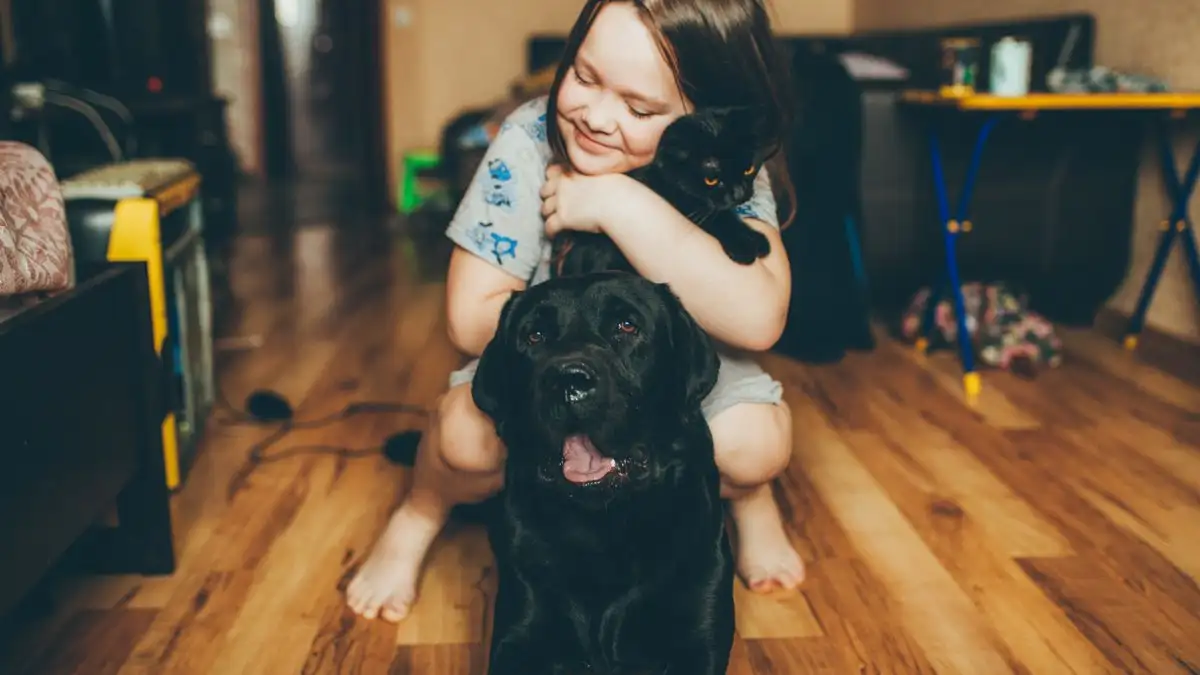
I learned that with our second puppy, when our daughter was two and our cat had been running the house for six years. The first week looked like almost nothing. Puppy in the playpen with a chew. Toddler on the kitchen floor six feet away, banging two blocks together, not looking at him. Cat on the back of the sofa, tail wrapped, watching all of it. That was the session. If I'd had a stopwatch it would have read eleven minutes.
Which is the part people miss. It looked like I wasn't doing anything. What I was actually doing was letting the puppy watch the household from behind a barrier until it was boring — because boring is the goal. A puppy that has watched a toddler scream for two weeks from a safe distance is a puppy that barely lifts its head when the same toddler screams at close range six months later.
The toddler is not a participant, the toddler is the environment
A two-year-old cannot follow handling rules, and no amount of repetition changes that this year. You can say "gentle hands" forty times a day and it will land sometimes and not others, which is exactly the problem — a rule that works eighty percent of the time is not a rule around a puppy with needle teeth.
So I stopped giving instructions and started changing the floor plan. The rule I settled on: the puppy's feet and the toddler's feet are never on the same patch of floor unless I am standing in it. Not the same room. In it, within arm's reach, with nothing else in my hands.
That is a heavier lift than it sounds at 6 p.m. when dinner is happening. It only works because the barriers make it possible. A gate across the kitchen doorway means the toddler can be loose in one space while the puppy is loose in another, and neither of them is being managed every second. That is the whole trick — the barrier carries the supervision when I can't.
The other thing I had to accept: the puppy gets the short end of the freedom stick for a while. The toddler keeps his run of the house because he doesn't understand a thing. The puppy gets a pen, a gate, and a schedule. That feels unfair and it is temporary, and it works.
Two resting zones, and one of them is off the floor
The puppy needs a spot the toddler's hands can't reach and the cat doesn't want. Ours was a playpen in the corner of the living room, plus a crate at night, and the pen was the one place in the house where nobody touched him. Not the toddler, not the cat, not me unless something was wrong. That rule held for months and it bought me a puppy who would actually settle in it.
The cat needs something different: a route out that stays above or behind a barrier. In our house that meant the back of the sofa, the windowsill above it, and a hallway she could reach without crossing the puppy's pen. Cats don't fight over territory so much as they avoid being cornered in it. When she can leave a room without walking past a puppy, she usually leaves. When she can't, she has one tool left, and it's a paw.
A hiss or a swat is a cat ending an interaction she couldn't otherwise end. A growl from an adult dog is the same kind of sentence, in a different language, and it's over in a second. Neither one is a problem to fix in the resident animal. My job isn't to teach the cat to tolerate a puppy. It's to make sure she never has to.
The cat sets the pace, and the pace is slow
I made the mistake of thinking the cat would come around on my schedule. She didn't. What actually moved things forward was the puppy being unable to chase her — which meant the pen, the gate, and a leash dragging on the floor inside the house so I had a handle if the puppy bolted.
For the first two weeks she watched from furniture. Around week three she started crossing the living room instead of going around it. By two months she was walking past his pen on her way to the food bowl with a look on her face like he was furniture. That's a good outcome. It is also not full contact, and it doesn't need to be. Some cats end up sleeping near the dog. Some never willingly touch him for ten years, and that is a perfectly fine household. A truce is the goal, not a friendship.
A growl is information, not a discipline problem
When we introduced our puppy to my parents' older dog in their fenced backyard — neutral ground, nobody's house, nobody's couch — the older dog gave one low growl when the puppy bounced into her face. It lasted half a second. The puppy dropped, turned, and went to sniff a bush.
That's the whole exchange. The older dog said "not that close" in the only language she has, and the puppy listened, and now they can be in the same house.
What I watch for is the puppy that doesn't listen. If the growl happens and the puppy keeps coming, the growl will escalate, and the escalation is the part you want to avoid — not by scolding the dog who growled, but by removing the puppy. I call the puppy away or walk him out of the yard and we try again shorter, later. The resident dog's routine stays exactly as it was: same bed, same walks, same feeding spot, same end of the couch. The newcomer adapts to the house. The house does not adapt to the newcomer.
Jobs are for the older kid, not the toddler
By six or seven, a child can hold a job, and jobs are worth more than play. Concrete, unexciting, repeatable things: fill the water bowl, drop a treat into the pen, sit on the couch and read out loud while the puppy chews. My son being the person who refills the water made him background noise in the puppy's mind — good background noise, the kind you don't get excited about.
"Go play with the puppy" does the opposite. It teaches a puppy that children are squeaky toys that move fast and make noise, and that lesson is hard to unlearn. If a kid wants to be involved, give them a chore, not a wrestling match.
Bowls and chews are separated from day one
The most common early flashpoint isn't the couch or the doorway. It's a resource. A food bowl, a bully stick, a stuffed toy that all three of them have opinions about.
So from the first day: the puppy eats in the pen or in a closed room, the cat eats on a counter or in a room the puppy can't reach, and chews live in one place. Any toy that gets carried around gets put up when the cat is in the room. Guarding starts small — a stiff body over a bone, a sideways glance — and it's much easier to never create the habit than to unwind it later. If the puppy already stiffens over food, the fix is distance and separation, not a correction.
Supervising means watching, not being nearby
This is the one that humbles me every time. Active supervision means my eyes are on the interaction. Not my body in the room, not my ears tuned for a yelp, not me scrolling with one hand while the puppy and the toddler are on the same rug.
There's a real difference between being present and watching, and the puppy finds out which one you were doing before you do. I started treating it like a shift: fifteen minutes of actual watching, phone on the counter, then the puppy goes in the pen and I get my brain back. Fifteen minutes of real supervision is worth more than an hour of half-attention, and it's sustainable, which matters, because this goes on for months.
How long, and what "done" looks like
There's no clean finish line. What I noticed was a slow subtraction — the gate came down for an afternoon and went back up that night, then stayed down for a week, then permanently. The cat stopped taking the long way around. The puppy stopped getting up when the toddler cried. Somewhere around four or five months, the house stopped being three separate territories and started being one house with three animals in it.
Some of that was training. Most of it was geometry: who could go where, who could get away, who couldn't be reached. If you get the barriers and the rest zones right, the training mostly takes care of itself. You're not socializing a puppy to toddlers and cats in general. You're socializing it to yours, in the only building it lives in, and the rest of the world can wait until the house is calm.
