Adjusting portions around a body condition score comes down to a loop: score the dog by hand, fix the measurement tool so the change is real, take about ten percent out of the total day's food including treats, and then leave that amount alone for two to four weeks before deciding anything else. The score is not the instruction. The direction it moves over a few weeks is. Most owners cut too much, too fast, and by the time the trend would have shown up they've already given up and gone back to the old scoop.
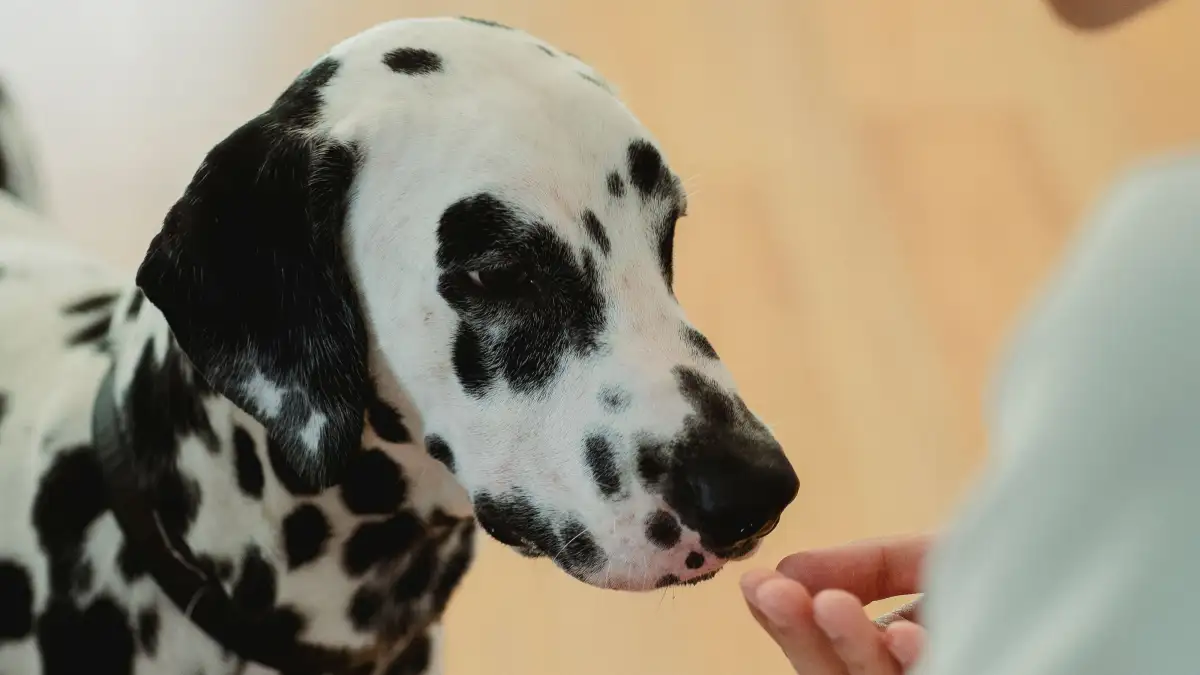
I'll stand at the counter with you, because that's where this gets decided. It's just after six in the morning. The kettle is going. Your dog is leaning on your shin with that stiff-legged brace that means the bowl should already be down, and there's a plastic measuring cup buried in the kibble bag — the one from the last bag, which may or may not be the right size for this food.
Before you look at the dog, look at that cup. Every decision you make for the next two months is going to be built on whatever comes out of it, and a cup is the loosest measurement in the kitchen. Scoop level, scoop heaped, scoop shaken down: same food, same hand, easily twenty percent apart. So the cup goes. What replaces it is a kitchen scale you already own, set to grams.
Score the dog with your hands, twice, four weeks apart
Here's the part that isn't about feeding yet. Three checks, done standing behind your dog, in this order.
Ribs first. Lay your palms flat on the chest and press in gently. On a dog at a good weight the ribs should feel like the back of your hand — you can find them without digging, and you can't see them from across the room. If you have to search, the dog is carrying more than it should. If they stand out like knuckles on a fist, it's carrying less.
Then stand over the dog while it's square on all four feet and look down. There should be a visible waist, a slight indentation behind the ribcage before the hips. Finally, look from the side: the belly line should rise from the chest toward the hind legs instead of running flat or sagging.
Scored on the usual one-to-nine scale, four and five are where most adult dogs should sit. Six is the dog you live with comfortably but keep an eye on. Seven and above is where I'd start changing the bowl.
Two things about that score matter more than the score itself.
The first is that you do it with your hands, not your eyes. A husky, a golden, a doodle in winter coat can look like a barrel and feel like a five. A short-coated dog can look fine and feel like a six. Hands don't get fooled by fur.
The second is that one score is a photograph and four scores are a film. Score the same way, in the same light, at the same time of day, with the same hands — yours. Don't score right after a meal, don't score a wet dog, and don't score two days in a row and expect to see anything. Write the date and the number on the fridge or in your phone. Two to four weeks between checks is the window; inside that, what you're reading is water, stool, and last night's dinner.
Then weigh the food, because a shape score can't fix a bad scoop
Weigh one level cup of your specific kibble exactly once. Note the gram number. From then on, you talk in grams, not cups. Kibble density varies between brands and even between formulas of the same brand, and the difference across a full day adds up faster than people expect.
Put the bowl on the scale, zero it out, and pour until you hit your number. This is the boring step, and I'll say it plainly: it's the step that makes everything else work. A portion change that isn't measured isn't a portion change. It's a mood.
Cut about ten percent, and count the treats inside it
Add up the whole day before you change anything. Meals, plus every biscuit, every training reward, the peanut butter in the Kong, the crust your dog talked you out of, the cheese at the vet's. That total is the number you're working from, and ten percent of it is your cut.
If the day runs 300 grams, you're looking for 30 grams. That's it. Not half the bowl. Not "a bit less and see." A cut small enough that the dog barely notices and you can hold for a month is worth ten times more than a dramatic cut you abandon on Thursday.
Treats come out of the bowl. This is the single most useful habit in the whole routine. Most dogs are already getting a meaningful slice of their daily food in treats, so trimming the extras can get you most of the way to your ten percent without touching the meals at all. If your dog will work for kibble, you just got free training rewards. If it won't, break the treat into quarters. Your dog counts events, not grams — four small pieces register the same as one big one.
Keep the number of meals the same, too. Two meals stays two meals, three stays three. A smaller amount in the same rhythm reads as normal. A skipped meal reads as a crisis.
Some owners stretch the volume with a handful of plain thawed green beans or a spoonful of plain pumpkin. That's a comfort measure, not a fix, and if your dog is on food your vet has prescribed, or manages a medical condition, that call belongs to the vet.
More walking is good. It's not the lever.
Add activity, and add it slowly — a dog carrying extra weight is loading its joints, so start with ten extra minutes and let the dog set the pace. Sniffing walks count. But be honest about the math: a longer walk does not undo a heaped scoop, and exercise on its own rarely moves a body condition score. The portions are the lever. The walking is what keeps the dog comfortable and cheerful while the portions work.
What to do at the next check
Two to four weeks later, same hands, same scale.
If the ribs are a little easier to find, the change is working. Hold the amount exactly where it is and keep going. I'd rather you sit on an amount for an extra two weeks than cut again out of enthusiasm — the trend is your friend, and overshooting lands you with a hungry dog, a household that feels guilty, and a rebound.
If nothing has moved at all, take another ten percent off the total day and run another round. Two or three rounds of this usually takes a dog from a six to a five. Slow isn't a compromise here. Slow is the method.
Where this stops being yours to decide
A few dogs shouldn't be portion-adjusted off a shape score. Puppies are supposed to be lean and they're still growing, so their number moves on its own schedule. A pregnant or nursing dog is eating for more than herself. Senior dogs lose muscle along the spine and can feel different than they look — a bony topline on an older dog is not the same finding as fat over the ribs. Sighthounds look thin at a perfectly healthy weight. I won't pretend this part is universal, because it isn't.
And if your dog is on a vet-prescribed diet, or has thyroid, joint, or heart issues in the picture, the plan comes from the clinic, not the kitchen scale.
What you're building here isn't a diet. It's the habit of looking at the dog instead of the bag, measuring what actually goes into the bowl, making one small change at a time, and having the patience to let it show up. Do that for a couple of months and the two numbers — what you scoop and what you feel under your hands — stop arguing with each other.
