A senior dog's day works best when the skeleton of it stays fixed and the distances don't. Keep the same wake-up hour, the same order of events, the same routes, the same rest spots, and let only the length and effort of each block flex — decided by how the dog moved last night and how he's moving this morning. The reason this goes wrong for so many people is that we plan the day as one piece: the long morning walk, the afternoon, dinner at six. Broken into short blocks instead — three small outings rather than one big one, enrichment treated as a real load rather than a bonus, and rest scheduled into the middle of the day instead of treated as whatever's left over — the same dog can hold a rhythm for months that one long walk would wreck in a week.
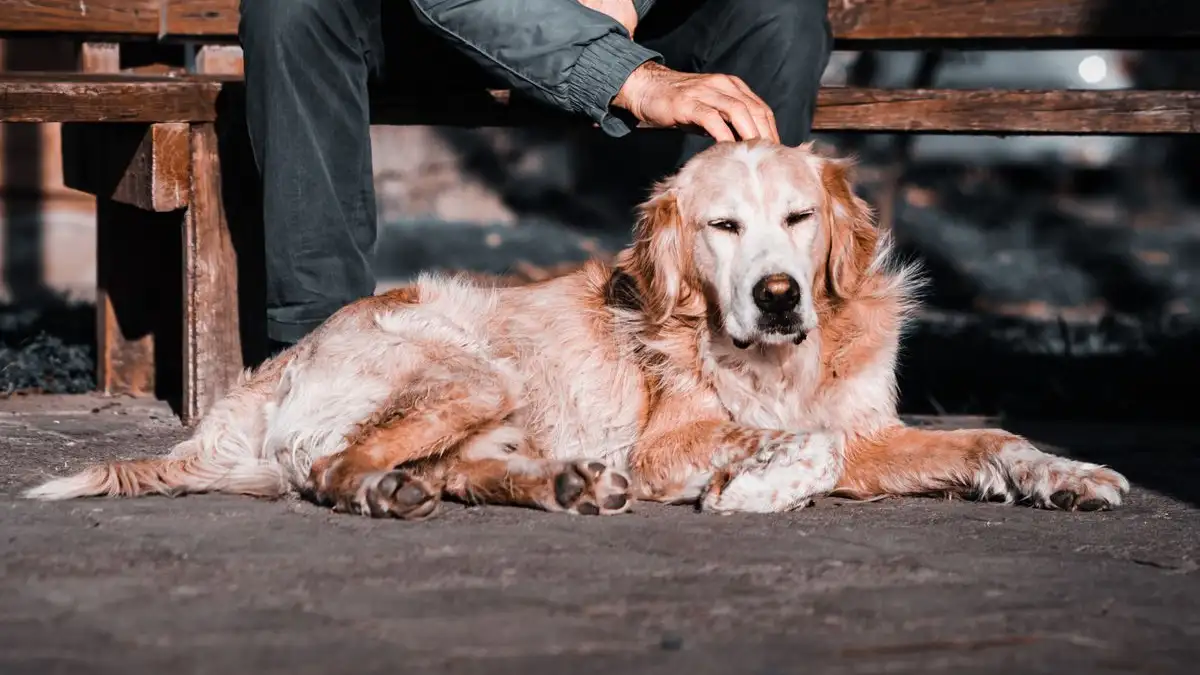
It's 6:40 in the morning, the kitchen tile is cold under one bare foot, and the leash is already in my hand. The dog is at the back door and he stops — front feet on the mat, back feet still on the tile, head low, waiting on something I can't hear. Two years ago he hit that door like it owed him money. That pause is the whole article. Everything below is what I do with it.
The back door sets the size of the first block
The first trip outside is not a walk. It's the yard: door open, three steps to the grass, the same shrub sniffed, a pee, back inside. Ninety seconds, maybe two minutes, and I don't put shoes on for it. Whatever the day turns out to be, it starts with a bathroom trip that costs him almost nothing. If he's slow coming up off the floor this morning, he does it six feet from the door instead of a quarter mile down the street, and the morning hasn't failed. It's just been scaled.
Breakfast goes into the bowl at the same time it always has, in the same corner. Then he lies down on the mat two feet away, and that's the first real rest of the day — not a nap I feel vaguely guilty about, a block on the schedule. A dog who knows what happens next doesn't spend his morning bracing for a surprise, and that saved energy is not a small thing for an old body.
Same order every day, different distances
What stays fixed: meal times inside a half-hour window, the sequence of the day, the direction of the routes, the place where he sleeps. What moves: how far, how long, how many times, and on what surface.
Consistent timing is doing two jobs at once. It keeps the bladder and the gut on a clock, which was most of what house-training ever was and still is at this age, and it means an outing doesn't have to be long to count. The dog isn't waiting to find out when he eats or when he goes out; he already knows, so the short version of the day still feels like the day.
The mistake I made for a while was changing everything at once — shorter walk, different route, later hour, new surface — and then having no idea which change helped and which one hurt. One variable at a time. If the walk gets shorter, the route and the hour stay put.
Split the outing instead of stretching it
Fifteen minutes around nine, ten minutes after lunch, fifteen more around five-thirty, plus a couple of yard trips in between. On paper that looks like more work than the single forty-minute loop we used to do. It isn't. The old loop ended with both of us standing at the corner while he decided whether the last two blocks were worth it, and I spent the walk home doing arithmetic about whether I should carry him.
Two pieces of the outing carry the weight now. The first is the warm-up: two or three minutes on a loose leash with no destination, just letting him read the same strip of grass he reads every morning. The second is the same thing at the end, in front of the house, before we go inside. Sniffing is low-impact, it's mostly what he wants to do anyway, and it lets me make nine minutes feel like a real outing instead of a chore.
The turn-around rule is simple. Head home while he's still willing to walk home at his own pace. If the last stretch has me stopping and waiting, or the leash is taut because I'm pulling and he's lagging, the walk was too long — the next one gets cut by about a third and moved to a softer surface. Grass and packed dirt are kinder than sunbaked asphalt, so in summer I test the pavement with the back of my hand before we leave the driveway, and in winter we do the plowed side of the street and skip the icy one entirely.
Rest is a place you build, not the leftover hour
Two or three down periods a day, roughly at the same times, in the same spots. He has a bed in the living room and a mat in the kitchen, which matters more than I expected. When there was only one bed at the far end of the house, he'd follow me from room to room and never actually settle. Two beds solved it without any training at all.
The runner rug in the hallway is not decoration. A dog who slides when he gets up on hardwood starts hesitating before he gets up at all, and that hesitation is hard to unlearn. Same idea with water: the bowl sits within a few steps of wherever he rests, so drinking isn't a trip.
And rest isn't only night sleep. If the only real rest he gets is from ten at night to six in the morning, the whole day is being run on a deficit.
Enrichment is a load, so don't stack it
A handful of kibble scattered in a folded towel. A snuffle mat. A puzzle with dinner in it. A kong that's been in the freezer since Tuesday. Ten minutes of nose work leaves my dog flatter than the walk does, which took me a long time to believe because it looks like nothing is happening.
So they don't go on the same block. If the puzzle is the event of the afternoon, the afternoon walk gets shorter. And I don't put the puzzle down the minute we come in from a walk, because two loads back to back is how you end up with a dog who's stiff the next morning and an owner who can't figure out why. Enrichment is the easiest place to overdo it, precisely because it doesn't look like exercise.
Potty breaks move closer to home before the walks get shorter
Frequency up, distance down. He needs one more trip than he used to, and the extra one lands late in the evening, right before bed. It's three houses and back with the porch light on, and it's non-negotiable in a way the afternoon walk isn't.
I also keep a bad-day loop in my pocket: out the front door, to the corner, home. That loop works in rain, in heat, in snow, and on days when he's just slow, and it counts as a complete outing. When the weather is miserable, that's the whole day outside, and nothing has been lost.
If he starts having accidents after years of being reliable, that goes to the vet rather than to the calendar. Moving a potty break earlier is a scheduling fix; a change in a house-trained dog's habits is a different question.
The real measurement is tomorrow morning
One line a day, in a note on my phone. How far, on what surface, how he moved on the way home, how he got up off the floor the next morning, how long it took him to settle after dinner. Five fields, ten seconds.
The reason for the record is that memory is generous. A week of short walks starts to feel like a week of good walks, and then a hard morning arrives with no explanation. With the note, the explanation is usually two days back — a longer loop, a harder surface, two loads stacked into one afternoon. If tomorrow's rise is slower or he takes longer to settle at night, the next walk gets shorter and softer. It's not a system so much as a way to keep myself honest.
It also helps to read the day he's having rather than the day I planned. Some dogs are better in the morning, some come alive at dusk. The main outing should land in his good window, even if that means moving it and leaving everything around it where it was.
Half is not failure
The trap I fell into first was all-or-nothing. If he couldn't do the old walk, then the walk wasn't worth doing, and we'd skip it and both of us would sit around feeling like something had been taken away. If he won't go past the driveway, we do the driveway. Sniffing the same mailbox for four minutes is still his outing.
The opposite trap is rebuilding the day from scratch every morning to match his mood. Predictability is most of the benefit. Fixed hours, flexible mileage — that's the whole trick, and it's a lot less work than it sounds.
What a routine can't do
A new limp, a sudden refusal to go out at all, pacing at night, confusion in the evening, accidents in a dog who's been clean for years — those aren't schedule problems, and shortening a walk won't answer them. A well-paced day makes a comfortable old dog's life easier. It doesn't replace a vet visit, and when I'm not sure which one I'm looking at, the walk gets shorter and the phone call gets made.
The last trip out is the porch light, three houses, and back. Same door as 6:40 in the morning, same pause on the tile, shorter grass. He's asleep before I've hung the leash back on its hook.
