The feeding chart on the bag is a starting point, not an answer. The number that actually carries you from bag to bowl is the calorie statement — usually printed in small type as kcal ME per kilogram, sometimes with a per-cup or per-can figure sitting beside it — and the thing that tells you whether your starting point was right is your dog's body condition: ribs you can feel under a light cover of fat, a waist you can see from above. Read the chart, do the arithmetic, then put your hands on the dog. The chart starts the job. The dog finishes it.
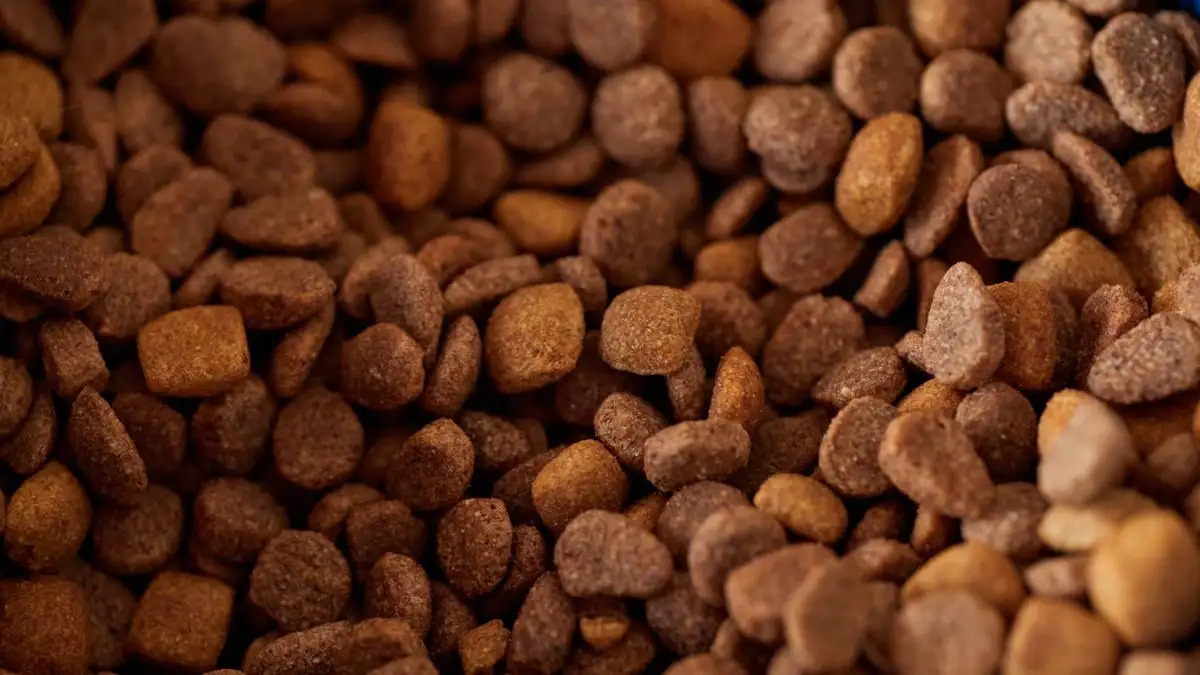
I keep a cheap digital kitchen scale on the counter, parked between the coffee maker and the food bin. It lives there because of a morning when I stood in the kitchen squinting at the back of a bag, trying to read pale gray type under bad overhead light, while a certain dog leaned against my shin and sighed. Same amount, every meal, for months. I had no idea whether it was the right amount, and nothing on the front of the bag was going to tell me.
Turn the bag over. That's where the argument is.
The guaranteed analysis isn't the number you need
Everyone reads the protein and fat minimums first. They matter for other reasons, but they say nothing about how much food belongs in the bowl. What you're hunting for is the calorie statement, and it hides near the feeding directions, in the smallest type on the package. It reads something like "Metabolizable energy 3,650 kcal/kg" or "385 kcal ME per cup."
The per-kilogram figure is the manufacturer's measured energy density for that formula. Metabolizable energy means what's left for the dog after digestion — not the raw energy sitting in the ingredients. When a company also prints a per-cup or per-can number, you're finished. Note it and move on.
When they don't print it, you build it yourself, and that's a five-minute job.
Converting kcal/kg into kcal/cup
"A cup" on a pet food label means a standard 8-fluid-ounce measuring cup, about 240 milliliters, filled level. That's a volume measurement, and kibble is a solid with a lot of air between the pieces. So the same cup of two different foods can weigh noticeably different amounts. Most dry foods land somewhere around 3 to 4 ounces of kibble per cup, which is roughly 85 to 115 grams — and that spread alone swings the calories by close to a third.
Weigh one level cup on your kitchen scale. Say it comes out at 100 grams. The conversion is:
calories per cup = calories per kilogram x (grams per level cup / 1,000)
A food labeled 3,650 kcal/kg with a 100-gram cup works out to 365 calories per cup. If the same formula measures 90 grams per cup, you're at about 329. Identical scoop, identical dog, eleven percent less food. Over a week that's most of a meal, quietly missing.
That one multiplication is also what lets you compare the bin in your kitchen with the bin at your mother's house, or answer whether a cup of the new food is more or less concentrated than a cup of the old one. You need both per-cup numbers. Without them, people compare scoops, and scoops lie.
Wet food and cans
Cans and pouches often print kcal ME per can rather than per kilogram, because the can is the unit. Same principle applies: find the energy number, find the unit it's attached to, and work from there. If only a per-kilogram figure is printed, you'll have to weigh out a portion of the food to build the per-ounce or per-can value.
Why the chart on the back has a range instead of a single number
Feeding directions have to state a daily amount by body weight, and they usually come as a band — something like "1 to 1 1/4 cups daily for dogs weighing 30 to 40 pounds." That band is not laziness. Two things force it.
First, the directions are written around the calorie density of that specific food, so a denser formula will show a smaller volume for the same weight of dog. The chart is really a volume chart for an energy number. That's why two bags can say different things about the same dog.
Second, the company has no idea who's eating. It has to cover a spayed four-year-old that sleeps on the couch and an intact two-year-old that runs the fence line all afternoon, and both of them can weigh forty pounds. It splits the difference and prints a range. You get to decide where in that range your dog actually lives.
Weight doesn't scale the way most people assume
Here's the part that surprises almost everyone. Maintenance energy needs don't rise in step with body weight. They scale with body weight raised to roughly the 0.75 power — what nutrition people call metabolic body weight.
In plain terms: double the dog, and you don't double the food. Two raised to the 0.75 is about 1.68. Going from 20 pounds to 40 pounds raises the requirement by roughly two-thirds, not by double. This is why the rows on the feeding chart crowd together as the weights climb, and why the jump from the 20-pound row to the 40-pound row never looks as big as people expect.
Small dogs burn more per pound than big dogs. That's the same relationship seen from the other end.
What moves a dog up or down the range
A neutered adult generally needs fewer calories than an intact dog of the same weight. A dog that naps through the afternoon needs less than one with a job. Senior dogs usually drift downward. Puppies, working dogs, and dogs kept outdoors in cold weather usually go the other way, needing more per pound than the average adult pet.
You cannot see any of that from the bag. You can only see it in the dog.
Body condition is the dial, and it's a hand measurement
Once a week or so, before the evening meal, I run my hands along the dog's sides. Flat palm, light pressure. The ribs should feel like the back of your own hand — you can find each one through a thin covering, without pressing in. Standing over the dog and looking down, there should be a visible tuck at the waist behind the ribs. From the side, a belly that rises rather than hangs.
That's the check. Not the scale alone, not the chart, not what the dog next door eats. Ribs buried under a padded layer with no visible waist means the amount is over what that dog needs right now. Ribs standing out sharply with hip bones showing means it's under. Either way, the chart was a guess and the hands are the verdict.
Weigh the dog on the same scale every few weeks, too — the veterinary office will usually let you use theirs if you ask. Weight is the slower, smoother signal; body condition is the fast one. Together they tell you which way to nudge.
Scoops drift, grams don't
Kibble settles. A scoop pulled from a full bin weighs more than a scoop from a nearly empty one, because the bottom of the bin is packed. Scoop sizes vary between packages and between two scoops in the same drawer. And "heaping" versus "level" is a difference nobody measures consistently at six in the morning.
So weigh the portion. Find the grams that match your target, write it on a strip of tape on the bin lid, and use the scale. It takes four extra seconds and removes the largest source of error most people have.
Treats come out of the total, not on top of it
The commonly quoted guideline is that treats stay within about 10 percent of a dog's daily calories. What that means practically is that treat calories are a subtraction from the day's food, not an addition to it. If training is heavy that week — a new puppy, a new skill, a lot of repetition — the dinner portion comes down a little to keep the day's total roughly level.
When the bag and the dog disagree
Trust the dog. Every time.
Then wait. Adjust in small steps, a few percent at a time, and give it two or three weeks before you judge the result, because body weight moves slowly and a single morning's reading will lie to you. A sudden change in how much a dog eats, or a dog losing weight while eating normally, is a veterinarian's question, not a chart question. Same for deliberately taking weight off a dog, or feeding around a diagnosed condition — that's a conversation with someone who can examine the dog, not with the back of a bag.
The chart got you into the right neighborhood. Your hands do the rest.
