A workday dog routine holds together when it hangs off four fixed transition points instead of a clock: the moment you leave the house, a midday reset, the moment you walk back in, and the last trip outside before bed. Meals, potty breaks, exercise, and rest all get bolted onto those four anchors. Once they're set, a late meeting or a long commute bends the middle of the day without breaking the whole thing.
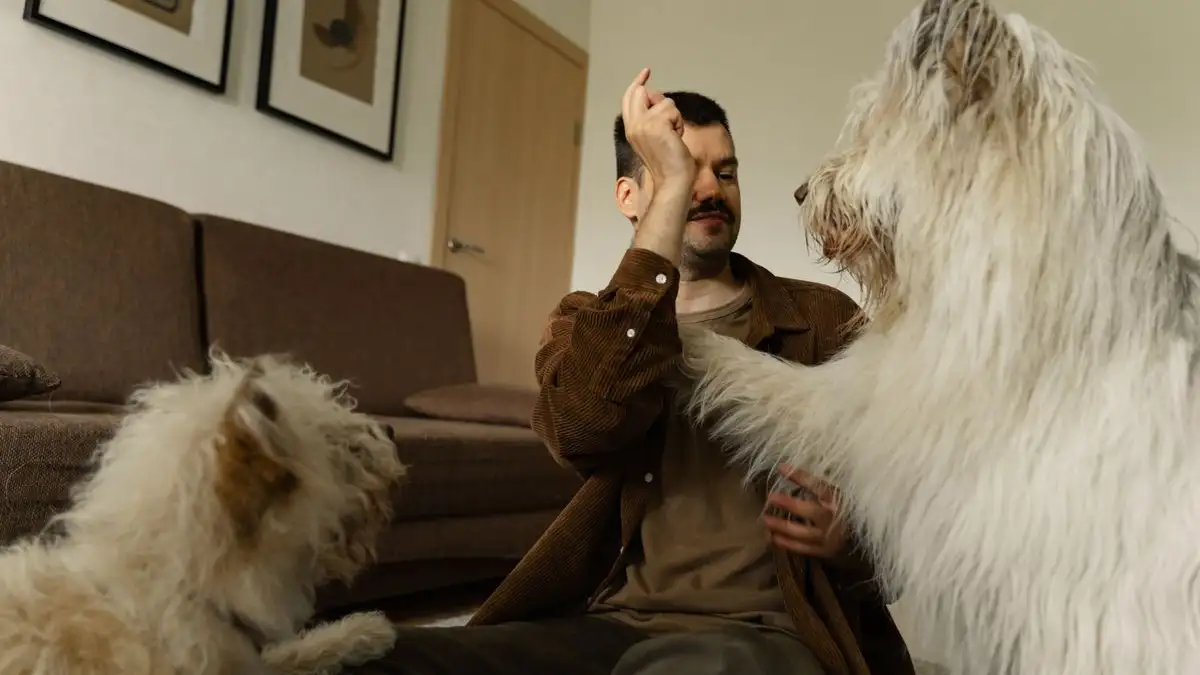
I'm standing at the kitchen counter at 6:32 on a Tuesday with one shoe on and the coffee running, and my dog has already stretched herself across the doorway with her chin flat on the tile. She's watching the leash hook beside the door the way you'd watch a clock about to strike. She doesn't know it's Tuesday. She knows the order: coffee, shoes, bowl, leash, door.
For a couple of years I tried to run her day by the clock, and it worked right up until my job stopped cooperating. What I found was that the clock was never the part that mattered. The transitions were. Those four moments happen every weekday whether or not I'm organized, and they're the only parts of the day I can actually control from a desk across town.
The leaving point
The morning is where most people get the order wrong. They wake up, feed the dog, drink coffee, answer two emails, then head for the door, and then wonder why they're standing outside at 7:40 with a dog who suddenly needs to go.
I do it the other way. Shoes on, back door open, dog out. That first trip is not negotiable and it happens before breakfast, before the phone, before anything that could swallow ten minutes. Then the walk, then the bowl, then the door. She eats and then has time to settle while I'm finishing up, which for my dog has always been the calmer order.
The sequence is the message. My dog reads the coffee grinder as a warning that the door is coming. She reads the shoes. If you flip the order, bowl first and walk later, nothing terrible happens, but you lose a few days while the dog relearns the pattern, and in those few days you get a dog who's underfoot every time you stand up.
The middle of the day
Nobody can tell you whether your dog needs a midday break, and anyone who hands you a number is guessing. Some adult dogs sleep straight through an eight-hour stretch without an issue. Mine did for years. Then she got older, and the stretch that used to be nothing became the part of the day she struggled with.
The way you find out is by watching for a week rather than deciding in advance. Pay attention to what you come home to. A dog who's been asleep and lifts her head when the door opens is telling you the day is fine. A dog who's waiting at the door with her weight forward, or who's been pacing, or who's had an accident she's clearly unhappy about, is telling you the stretch is too long. Same dog, same house, different answer depending on size, age, health, and how much water she drank at noon.
If the stretch is too long, the fix only comes in three shapes: someone comes to the house, someone takes the dog out, or the dog goes somewhere for part of the day. A neighbor, a dog walker, a daycare. Those are the categories, and which one fits is a money and logistics question more than a dog question.
When you walk back in
This is the highest-charge five minutes of the day, and it's easy to spend it wrong. I come home to a dog who's been alone since morning and is now vibrating with the fact that a person exists again. The reunion is lovely. It is also not the priority.
Leash first. Out the door or into the yard before the petting, or you'll be standing in the kitchen twenty minutes later with a dog who's been holding it the whole time while you scratch her ears. Then the real walk, the one that counts as exercise, not the one that counts as a bathroom trip. On days when the weather is bad or I'm running late, I take her out for the same fifteen minutes and let her sniff everything instead of walking a straight line. That trade is better than people think.
The last trip out
Nobody wants this one. It's 9:45, there's nothing happening outside, the dog walks three steps onto the grass and turns around. It is also the trip that makes the 6 a.m. wake-up possible, and skipping it is how you end up standing in the yard at 3 in the morning.
The last trip is where the slow stuff gets done, and the slow stuff matters. A dog who gets fifteen unhurried minutes to stand and read the yard at the end of the night settles faster than a dog who gets a rushed loop around the block.
What fills the space between the anchors
Two meals a day is the usual shape, spaced somewhere around eight to twelve hours apart and adjusted to the dog's size, health, and activity level. On a workday that spacing mostly takes care of itself. Breakfast before you leave and dinner after you're home lands you around eleven or twelve hours. If dinner is at 5:30 and breakfast is at 7 the next morning, you're closer to fourteen, and for some dogs that's a stretch worth narrowing, especially small ones, seniors, and dogs who get a lot of exercise.
Exercise is the part where a number would be comforting and wrong. Breed group, age, and current fitness do the deciding. A twenty-minute brisk walk on a sidewalk is not the same workout as forty minutes of stopping at every third mailbox, even though the second one covers less ground. Watch the dog at the end of it, not the watch.
And for a lot of adult dogs, the mental side does more work than the physical side. A food puzzle, a five-minute training session in the hallway, a walk where the dog gets to decide where to go. Those tire a dog out in a way that a longer march down the same sidewalk doesn't. I lean on them hard on the days when the weather kills the walk.
Rest is the piece people leave out because it doesn't look like work. Adult dogs sleep a lot. Twelve to fourteen hours across a day is ordinary, not a problem to solve. What a full-time schedule needs is a clear end to the day, so the dog knows when activity stops. After the last walk, the lights go down, the toys go up, nothing interesting happens. It takes about a week before the dog starts putting herself to bed before I do.
What happens when the day bends
The anchors survive a nine o'clock meeting. They don't survive a schedule that changes every day. A dog who comes home to someone at five on Tuesday, nine on Wednesday, and noon on Saturday has no shape to learn, and the waiting becomes the hard part rather than the length of it.
So I keep the first trip and the last trip roughly fixed even on weekends. I sleep in on Saturday, but not by four hours. That's the trade. The routine costs you some weekend flexibility and buys you a Monday that doesn't fall apart. Give any new arrangement a full week before you judge it, and two if you can stand it. One bad Wednesday isn't information.
That's most of it. In practice the whole structure costs about ten minutes in the morning and forty at night, and it isn't really about the minutes. It's about the order. Get the order right, keep it boring, and the dog spends her day the way a dog should: asleep, mostly, waiting for the parts she already knows are coming.
